Within two days last week, three projects came to a happy conclusion. Not mine, alas, though I did manage to send off my draft of the Piers Plowman essay to my long-suffering editor.
No, I went to two book launches, and had the pleasure of ringing a PhD student to say her examiners' reports had arrived, and that all she had to do was make a handful of tiny changes.
The booklaunches were of two friends, and what a contrast they made! First was Paul Salzman, launching Reading Early Modern Women's Writing; and the second was Ken Gelder, launching Subcultures: Cultural Histories and Social Practices. Paul's launch was held in a lovely room at La Trobe University, with the sulphur-crested cockatoos flashing white through the soft greenery of the bushland campus against stormy grey skies. Speeches were thoughtful, modest and heartfelt; food and wine were plentiful; but the hardback Oxford volume was very expensive. The next night was Ken's turn. The launch was held in a Carlton bookstore (in fact, see Whitebait's terrific evocation of the event): more crowded; less food and wine; longer, cleverer, more self-referential speeches. Two immortal lines: a sentence from Justin Clemens, the launcher, beginning "My tattooist's sister... "; and another from Ken affirming that reading the book was a bit like a slap for the reader (for the record, Ken said he thought this was a good thing). The Routledge paperback was half the price of Paul's.
This is the divided world of scholarly publishing, then. It's not completely schizophrenic, though you don't need a degree in semiotics to decode the contrasts here. What is particularly wonderful about these two events is that Ken and Paul are friends and collaborators. They've already produced a study of Australian fiction, The New Diversity, and are at work on a sequel. Both their careers are models of versatility and productiveness. Paul's, in particular, I find instructive, as he balances work as a specialist in early modern literature with his work on Elizabeth Jolley and Australian fiction. For better or worse, it's pretty hard, in most Australian departments of English, to focus just on one research and teaching area. Most of us medieval and early modern folk have very few colleagues in our immediate areas, and often end up teaching and supervising in other areas. Which is why we travel so much; and why we love blogs and conferences so much. I say this with some feeling today, having just given a lecture on D. H. Lawrence to the first-years this morning...
On the other hand, last night we had about eighteen folk gathering for the monthly Medieval Round Table, hearing a wonderful paper from Kathy Troup on the patterns of marriage amongst medieval brewers. This group has been meeting for over ten years now. It's a very diverse group, but meetings are always fascinating, and people are always friendly, interested and supportive of each other's work.
In my graduate supervisions, I usually have about a third of my students working on modern women's writing, which brings me to the third moment of closure last week. At Melbourne the PhD is a thesis of 80,000 words written under the supervision of one main supervisor and an auxiliary supervisor whose main role until recently has been to step in at the end of the probation period, whenever the principal supervisor is away, and at the end of the candidature. On completion, the thesis is sent away to two anonymous readers who can't have had anything to do with the supervision process. With any luck, they'll agree the thesis is ready to be passed, but they can sometimes send it back for re-writing and re-submission. They are supposed to take only about six weeks to do it, but it's often a much longer wait until the candidate gets a phone call out of the blue with the good, or the reasonably good news. This was a part-time enrolment, so it had been a long haul project. Larissa had had two children over the course of her candidature, and more than her fair share of health and other kinds of interruptions to her work. The reports are in, now; and say lovely, positive things about her work: an analysis of Foucauldian heterotopic spaces in Australian second wave women's writing. We met last night to look at the reports together, and a mutually satisfying exchange of congratulations took place. Congratulations again, Larissa!
My own work now is to sit down and puzzle out what I need to take and do before I climb on the plane to London on Saturday. I'm off to the fabulous-looking London Chaucer conference on Chaucer and Time, and will spend some time in the British Library, the College of Arms and the Public Record Office in Kew.
Tuesday, April 03, 2007


Tuesday, March 27, 2007
Eco-systems: birds, fish, grief, magic
Pavlov's Cat has recently written a beautiful post about scattering the lint from her clothes dryer around the garden so that birds can use it as a soft lining for their nests. Apart from my feeling the way about her clothes dryer that some people feel about my dishwasher (and of course, I use it several times a week, instead of just when it is raining), this is a lovely notion; and her comments box indicates that others are similarly taken with this idea of co-existence.
My own feelings have come under some pressure in this regard recently, on several fronts, as I have been thinking about back yard ecosystems. Our own back garden was re-built with a series of ponds, stone walls and benches last year, and by the time I was recovering from surgery, the plants were settling in, the goldfish were breeding and learning to eat from my hand, and we had started to marvel at the difference made by these small bodies of water in the garden. Over the course of spring and early summer we progressively scooped out fallen quince, pear, and dogwood blossom, then elm tree seeds and jacaranda flowers from the ponds. I entertained my visitors in my "folly", a stone pergola with a wrought-iron cupola, and encouraged the stephanotis plants to race each other in climbing up and around their concrete columns. The garden was also the place where I taught myself, in a very rudimentary way, to meditate; even if this involved nothing more elaborate than sitting still and doing nothing.
When the eastern tree frog we called Herbert (von Karajan) came to live among the violets, we congratulated ourselves on having built something that might complement the indigenous plant environment, in the heart of the city. (We live on a busy thoroughfare, complete with trams running past the front door; but we can also cross a side street and be on the Merri Creek.) Paul then built a special swampy frog pond, in hopes of attracting more frogs. The garden, then, is an eclectic mixture of the "natural" environment, with more than a hint of gothic folly in its architecture and sculpture.
We were a little concerned about the fish and Mima, my fifteen-year-old cat, but she is more interested in following me around the garden, making nests in the mulch, and drinking the fish-flavoured pond water than risking getting her paws wet by going fishing. Since our neighbour's great-niece, partner and three-year-old daughter have moved in with him next door, we've also had to put a lock on the gate between the two back gardens: the human eco-system around us has also undergone a major shift, and we are conscious that small children and ponds, even shallow ones, are a dangerous combination. But the real sign of change in the relationship of people, water and animals has been the birds. We've always had thrushes, honeyeaters, wattlebirds, lorrikeets, miners and odd kookaburra perching in the elm-trees, a very odd sight indeed. And it's always seemed like a kind of blessing, when they fly into and through our trees.
Even when the garden-builders reported seeing a kookaburra swoop down and lift a goldfish out of the little trough under the tap, I was more thrilled by the oddity than scared for the fish. Then a few weeks ago I saw a lovely grey heron, standing awkwardly on its spindly yellow legs, up on the roof of the house, watching the pond, and watching me watching it, but not venturing any closer. And one day last week Paul saw a cormorant flying in and around the garden. He chased it off several times, and was concerned, but I was still blithely confident that the fish would be able to hide away, and was pleased at this sign that the garden was becoming such a rich eco-system.
Then one morning last week I came back from my walk along the creek and went into the garden to walk around with the Mimacat, and was horrified to see empty ponds, with not a single fish in sight. It seemed that cormorant or heron had come in and fished out the ponds completely; and I was overwhelmed by desolation and the destruction of it, and sympathetic horror for the experience of being a fish with a large bird swimming around and picking off the family members, one by one. Our little eco-system seemed no system at all, if the birds could be so comprehensive in their fishing. A few hours later, I went out again in disbelief, but saw one small shubunkin swimming quietly. Then an hour later, one or two more; and by the end of the day, most of the larger goldfish, two-thirds of the silver perch and all the rainbow fish had re-emerged. It seems they had been fast enough to take cover under the rocks and plants, and smart enough to stay there for most of the day. It was like a magical visitation. The destruction had seemed so comprehensive that all I could do was wish, against all hope, the fish were back. And there they were: the big comets Merlin and Charlotte (I like to think these are the breeding pair), and the two black ones Beadle and Bugelow, though the majestic black and gold one I called King Olaf Tryggvason (around the time Joel was doing a school project on his "ancestors") seems to have been amongst the casualties.
It's been a chastening event, all round. We are now thinking about putting tightly strung wires around and across the ponds: these catch any breath of wind and vibrate in a bird-deterring way. I know that cats and birds, and cats and frogs, and dogs and lizards are equally difficult combinations in the domestic garden. "Nature red in tooth and claw", my mother would say; and this was well before David Attenborugh showed us just how red Nature could be. But weirdly, the fact that the bird did not fish the pond out completely suggests that this *is* a functioning system: the bird hasn't exhausted the food supply, and has left enough fish to make it worth a return visit. Just let me get those wires strung across the water first.
Thursday, March 15, 2007
A little adjustment disorder
Over the last few weeks I've been struggling hard to find a rhythm and a routine for reading and writing. My dear visitors have gone home; my teaching has mercifully been reduced to about eight lectures over the course of the semester; and I have few regular meetings or commitments. I'm feeling stronger, physically, than I have for ages, and have established a good routine of walking along the creek for about 45 minutes each morning.
These would seem to be ideal conditions in which to catch up on some reading and writing, after the last five months since my diagnosis; and also, it must be said, after the few months last year when I was flinging myself from pillar to post, hardly ever sitting still long enough to read or to put a sentence together. Yet it has been almost impossibly difficult to work. I can barely sit at my desk, and check email, blogs, news and weather sites to a ridiculous degree, yet I'm unable to take myself off to the cinema or break the cycle. If I sit down to read, I fall asleep within minutes. I can feel physically strong when on the creek path in the morning, or on my bike, or even on the tennis court (had a great workout last Sunday, though I still can't serve), but when I go in to work I come over all feeble, and have to hold onto the stair rail, or the back of a chair, or sit down, when I used to dash about, and sometimes even literally run along the narrow corridor between the two halves of my building. And when I think about going back to full duties in second semester, I am liable to start panicking, start crying and feel anxious. This has been very distressing to me, as I have always loved my job, and loved going in to my office and seeing folk. I've revelled in the busy-ness of trying to balance my teaching and my research; and if I've moaned about committees, I've also enjoyed my share of knowing what's going on and how things work, and my part in making good decisions. All this seems to have changed.
It's taken me a while to work at untangling the threads making this particular knot. I don't think I'm over the worst of this (I had a cheerful and interesting appointment with Tash and a stand-in oncologist, Craig, on Tuesday but sobbed all the way home and for most of the rest of the day), but things look a little clearer than they did a few weeks ago, so let me try.
Some of the anxiety and fatigue might be attributable to the after-effects and side-effects of treatment and the effects of menopause; but I suspect this is more psychological than physical. At a party a few weeks ago, I was talking about some of this to Sandra, who named a psychological condition "adjustment disorder" which I looked up. It seems to appear within about three months of a shock such as illness or bereavement, and can be accompanied by depression, anxiety or other such things. It is to be distinguished from post-traumatic shock disorder ... but I'm far from trying to make an accurate self-diagnosis. I took great comfort in the idea that there might be a recognisable pattern to the way I feel. Someone else likened having cancer to traumatic shock, and I took comfort in that, too. I don't want to overdramatise the problem, but I don't think I have ever experienced anxiety of this kind before, and it was helpful to see that there might be a shape — a beginning and an end — to it. So I made an appointment with one of the counsellors through the breast clinic, but my appointment isn't till May (I'm in London for most of April).
I was so desperate the other night I let my partner sit me down and pretend to be my counsellor, and we came up with some concrete suggestions for how to manage the time at my desk, and I'm pleased to report that for the last two days I haven't opened email till after lunch. Mornings are for research; I don't have to accomplish any number of words or tasks; but all the reading and writing I do in those hours has to be on the project I've set myself. And I think I will get close, finally, to finishing this little essay on Piers Plowman soon. Ironically, I'm writing about Langland and the nature of work. Here's a sentence I wrote today: "Langland knew that writing was hard work, but seems unable to say this directly; and so in this regard, as in many others, the poem proceeds by indirection and dialectic." That's pretty funny, really: I wonder if that sentence will still be there in the final version!
So I'm trying to untangle the small-scale problem of how to read and write, while also tackling the larger issue of facing up to returning to work. It's certainly not made any easier in that the University is still in the throes of a major shake-up; my Faculty is suddenly deep in debt; my department has vanished; and my new school is facing staff redundancies as we all write new subject outlines for 2008 and beyond. I even found myself experiencing a sense of grief, and loss: I have spent my entire adult life at the university, and suddenly feel strangely detached from it. It's possible this is a good thing. This was Manfred's view, when we spoke about this at another party, that a little adjustment disorder might be beneficial, if it loosens the ties of duty and obligation in which I have bound myself so tightly. When I was talking with Suzanne in the meetings before my surgery, she said, "cancer changes your life." I am starting to see what this might mean.
Tuesday, February 27, 2007
Getting Better All the Time
Towards the end of my radiotherapy sessions, Kristy told me about a woman also receiving treatment at the same time as me. She'd had chemotherapy and lost all her hair, but would turn up every day looking fabulous: a wig or a hat, make-up, beautiful clothes. Then one day she arrived looking pale and wan, in drab clothes. Kristy asked if she wasn't feeling so well, but she apparently replied in a deadpan voice: "First day back at work."
I can absolutely understand this, as I slowly wind my way back into a fuller programme of work (writing; supervisions; eight lectures; a conference in London; and a research trip over the twelve week semester that starts this week). I'm feeling very wary of slipping into old ways of taking on too much, and don't trust myself to be strong enough to protect myself. There's no doubt I'm over the most difficult parts of my treatment, but while I'm starting to feel physically stronger in lots of ways, it's quite clear to me that I haven't yet finished being sick. In one sense it's lovely to feel some energy returning, but it's so clear to me that I can't return to the same life I was living before September, when the little dimple appeared and called a halt to life in the academic fast lane. I'm almost sorry I don't have some more visible sign of illness to protect me.
This is contradictory, of course: ten days ago I was sitting in a lovely restaurant with my partner and son, my writing collaborator and another dear medievalist friend. We had toured the amazing Werribee Mansion, and were just sitting down to a crisp white tablecloth and local Shadowfax wines, before heading to Torquay beach for the afternoon, and then tea with my parents. All of a sudden, I announced with deep, clear and joyful conviction, that I didn't feel like a sick person anymore. And it's true: I don't. I'm walking along the creek every morning for about forty minutes; and while my right arm is sore after playing tennis on Sunday and trying too hard, too soon, to start working on my serve (the scar under my arm feels pulled and strained today), I was, nevertheless, running around the court, and not feeling too tired by the end.
But I still feel, very clearly, that I haven't finished my recovery. There are still huge and clear limits to my energy levels, especially when it comes to drawing on reserves of emotional and social energy. I feel I have no such reserves any more. I still need a nap most days; I still quickly feel overwhelmed and a little panicky. I'm sure it's not at all like having a nervous breakdown; and yet I do feel as if I have, indeed, lost my nerve. Literally, of course, this is exactly what's happened: I'm still numb and tingly in sections of my arm and shoulder where the nerves were cut as part of the lymph node biopsy. In this case, the bodily metaphor has a literal correlative.
It's difficult to write about this, since I don't want anyone reading this blog to feel they are imposing, or creating difficulties when I have agreed to do things. I am directly responsible, myself, for my health and the careful decisions I've made about teaching and other projects over the next few months; and am only doing things I want to do. So no one needs to worry about that.
The other difficult thing to think about, and it's something I've been very coy about until now, is that I've had to tackle the idea — ok, the fact — of menopause, rather earlier than I was anticipating. Because my tumour had a high rate of responsiveness to oestrogen and progesterone, the recommended treatment is to lock down the body's response to these hormones (this is what the Tamoxifen tablets do). I'm also having the further treatment of monthly injections of a drug that effectively shuts down my ovaries (ovarian ablation is the term here). Menopause came on pretty swiftly: my body gave up its menstrual cycle without a word; and I'm having periodic hot flushes (or 'flashes', as they are called in the US; or 'power surges', if you are feeling confident and strong), but also sometimes cold flashes. Oestrogen, it turns out, helps you regulate your body temperature.
So far, this hasn't actually been too bad, but it's another reason why I feel I've barely begun to process everything that's happened. I haven't finished reading all the cancer-diet books; we only got about a third of the way through Middlemarch; I'm only just beginning to establish the meditation routine I began in December; and I don't yet know how to make the changes I want to make in my life.
Friday, February 16, 2007
Conferences, collaboration and koalas
Home again, back at the desk after just over a week away in Adelaide. It was a lovely conference: Lawrence was incredibly lucky with the weather (I see it's going to be 38 there today and 40 both days of the weekend); papers were great; and people were charming. This is a group where I know lots of people, and normally go to heaps of papers and hang out at Simon's bookstand and at morning and afternoon teas. This year it was an abrupt re-immersion into public life after my illness, and it was tough at times. I certainly didn't have the energy to go to papers all day, so had to make some hard choices, and time a nap back at the hotel every day. I found it easier to sit down than stand up, and easier to sit outside in the quiet sun than inside with all the conversational buzz. Since coming out of the slump after radiation therapy a few weeks ago, I'm physically feeling a bit stronger all the time, but am still feeling fragile in lots of ways. One of the symptoms is distress if I can hear too many conversations going on around me. I've always been completely intolerant of hearing two pieces of music at the same time, even in snatches of song or a tiny musical theme on the radio; and this has now extended to conversation.
Long before I was diagnosed, Tom and I had planned to circulate our paper for discussion prior to the conference, and this turned out to be a great idea, as we didn't have to stand up and talk. This is the first finished paper/chapter of the book we are writing on theories of medievalism and its relationship with medieval studies. Rather, Tom spoke for a few minutes; John gave his response (sympathetic, but also opening up some tricky avenues for future thought); and then there was time for a good discussion.
On my way to the paper, I passed a tutorial room and heard a familiar, dulcet voice explaining something. It was clearly a "teaching moment"; and it was also clearly Pavlov's Cat in full, eloquent flight, teaching a summer school. We met up with Paul as planned that night and it was a delight to see her looking so very well: her lovely face animated with conversation.
Adelaide turned on some beautiful restaurants and weather; then Tom and I hired a car and drove a group down to Port Willunga (long stretches of clean sand between magnificent cliffs and brilliant ocean), and then after the conference headed off with David and John towards Mt Gambier, where we put John on a tiny plane for his flight back to Adelaide. Medievalists on a three-day road trip! Fantastic weather; one or two exceptional meals; country hotels of mixed quality; and explorations into the volcanic and sandstone landscape along the coast: caves, sinkholes and craters one day; then cliffs and crumbling coastlines the next. A highlight was a dusk stop at Tower Hill, a volcanic site that is now a wildlife reserve: emus, kangaroos and koalas striking curious poses... We walked around the rim of one volcano in the heat, with just a frisson of uncertainty about whether we were on the right path or not, and were then rewarded when we came down with the sight of a koala and her baby taking a stroll then climbing up into the tree. Even later that day, as the setting sun was glowing off "London Bridge", a huge arched pile of sandstone on the way into Port Campbell, we also saw a little bandicoot on our path, exploring David's shoes, and then a young fox in the carpark. We were convinced it was playing hide-and-seek.
Generally, with one visitor from California, another from London and Philadelphia, and another from Cleveland and Iowa, I thought our fauna and flora put on a pretty spectacular show. We also made a stop at Penola, to research the life of Mary McKillop, Australia's only candidate for sainthood. I, of course, did not have a camera with me, but here is a picture of another pilgrimage site we visited: the sea wall at Portland where my father recently arranged this:

This Joel is my Joel's great-great-grandfather.
Since I've returned, I've re-written much of our grant application. Our whole team met in Adelaide, and worked through Sue's extensive comments. It was a classic case of initial resistance to many of her suggestions, before we realised just how canny and smart they were. I really hope we are just about done with it now. So much depends on these grants in this country. Sadly, one of the great incentives for applying is that once you get a grant, you don't have to apply again for another couple of years. Our team distinguised itself once again with its brilliant spirit of co-operation. I am now involved in three collaborative projects, and I am a total convert to their pleasures.
Saturday, February 03, 2007
I'm just starting to work on that now...
When I began this blog, I planned it in part as a record of the process of assembling an ARC grant application from the first hesitant germ of an idea to the highly polished 30+ page artefact that would sing sweetly to the readers and the panel alike. I did get some way into thinking about that new project, but then becoming ill meant deferring that project, and that grant, for a year, at least. I am currently, however, in the process of revising my collaborative application from last year's "near miss". With a great team and the efforts of Anne, our wonderful research assistant, the process hasn't been too bad, but I am nevertheless sitting at a computer on a hot Melbourne night reading and re-reading, tuning and fine tuning the draft, the budget, the justification for the budget, our track records, our justifications of our track records, our title, our summaries, our keywords, our codes.... We've changed the project slightly, and sharpened its conceptual frame considerably. Instead of looking at medievalist Australian literature alone, we're going to study Australian medievalism across four cultural fields. But every time we changed one thing, we had to change six more parts of the application that correspond to it. The ten-page "essay" got a whole lot longer, and then had to get shorter again to fit into the ten pages.
I have another couple of hard hours work to go on my end of it, and we are currently waiting for some colleagues to get back to us with feedback. Of course we want them to say it's wonderful, and that we don't need to make any changes. Paul is working on his own application tonight, and we will sit down and read each other's at some point tomorrow.
So instead of doing my round of revisions now, I'm sending a message of commiseration and fellow feeling to everyone else in Australia who's going through this annual torment. May GAMS remain easy of access; may your budget fall into place; may your ten pages stay ten pages; and may your keywords and codes bring you joy.
And a lovely p.s. to the snowglobe theme. Tom has arrived from Iowa this morning, bringing Joel a snowdome from Chicago (urban landscape; wooden base; plays music; glitter, not snow [which is increasingly rare in your modern dome] but lovely all the same). At LAX he was almost not allowed to bring it on the plane. As the security team pointed out to him, there's more than 3 fluid ounces of liquid in there...
Friday, January 26, 2007
And the winner is ...
... Ryan, who spotted the St Louis arch - aka Jefferson National Expansion Memorial - cramped into its snow dome, and snuggled up next to Big Ben and Gaudi's Cathedral, in the "after" shot of the previous post.

You would think the poor child's parents are never at home, though he has bought some of his collection himself. They are not all that practical as travel souvenirs: we brought five big domes home from the US in 2005, and that was about half a suitcase full.
There are a few St Louis readers of this blog who will be horrified to know that until I went to St Louis I had not heard of The Arch; but not many who've made the trip up inside it who will be surprised to know that until I made that ascent I did not really know the meaning of claustrophobia. A tram runs up and down each side of the arch, where each carriage is a tiny capsule seating five people (ten knees all touching) a few steps higher than the one beneath, and then the capsules then ascend like a string of beads, one above the other, till you come out at the top.

The Arch is much larger than it appears in the snowdome (as you might expect) and is a thing of great technical beauty.

And the view is extraordinary.


The Mississippi is also much larger than it appears in the snow dome, where it looks as if the poor boat (in fact, a floating casino) is about to sail off the face of a very flat earth.
Monday, January 22, 2007
Before and After
Dr Cat and Paula have been kind enough to imply that trying to write deathless prose for a book, an essay, and a grant submission on three different topics while at the nadir of radiotherapy treatment and its aftermath might not be the smartest thing I've ever done, in the struggle to find the perfect balance of body and mind. Has this blog taught me nothing?
The trouble for me is that writing, when it's going well — and even when it's more of a struggle — makes me happy and content. But since Paula gave me a firm reality check (and zucchini frittata and blood-plum crumble) on Saturday night, I've done no real work for a couple of days. And here are two photographs to prove it. First, the "before" shot:

And now, the "after":

First person to find the St Louis reference gets a chocolate....
Fortunately my grant collaborators are working at our draft while I recover (though one has a pre-school child and a baby to care for) and the other has a bunch of other applications from his faculty to read and assess.
According to the radiotherapy technicians, the worst of the burning should have emerged by today, so it should start to clear soon. When I was moaning to Paula the other night, I found myself saying I was sick of dragging my body around with me. I shocked myself, as I normally feel rather more integrated and connected than that. No wonder it's hard to work.
Friday, January 19, 2007

Wednesday, January 17, 2007
The Last Dance
Fifty-one calendar days and thirty-three radiotherapy sessions later, I've handed back my robe, distributed my chocolates (Lindt balls, naturally) to the other lockers, and been given my marching orders by the technicians and the nurses at reception. The message was clear: don't come back.
Paul set off early on his long-delayed trip to East Timor this morning, and my parents drove up from Grovedale to take me in to the hospital, bringing thoughtfully prepared pies and meals Joel and I can either heat and eat, or freeze for later. Example: a chicken and leek pie in a throw-away tinfoil case (no cooking; no washing up). They also brought me a fabulous present: a soft blue and white mohair throw-rug of dreamy lightness for my afternoon nap. It will be like sleeping in a cloud. OK, better for days when they aren't invoking the 'extreme heat' rule at the Australian Open tennis down the road, but still.
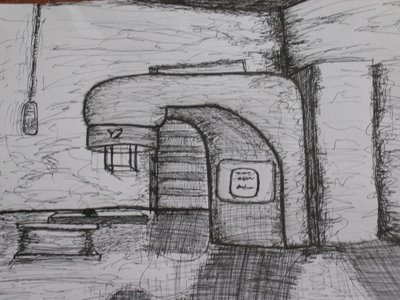
Joel, who has come to at least half the sessions with me, also brought the radiologists a present, a drawing he did over the weekend, from memory, of the second machine, viz:
Robyn and Peter will cook risotto for us tonight. And yesterday, when the temperature soared above 40, Paul's mother came and stood for hours in our sunny living room ironing right down to the bottom of the laundry baskets. At one point, it was so hot she moved the ironing board into the bathroom where it was slightly cooler. And it's not as if Jean doesn't have her own health problems. This was an act of love indeed: if ironing can save me, I'll live to be a hundred.
So I've finished the radiotherapy; Suzanne doesn't want to see me for nine months; and I think I heard Mitchell utter a cautious sentence yesterday with the word 'cure' in it. I'd give anything to wind back the clock again and listen properly. There are five more years of daily Tamoxifen tablets and monthly Triptorelin injections before he's finished with me, but in any case, I knew after my surgery that my prognosis would be good. Everything's gone smoothly; I've been treated beautifully; and my chances — and they are nothing but chances now — are good. The future looks bright.
I feel dreadful.
I'm a mess of sentiment and emotion. Margot came to the door yesterday afternoon and I fell into her arms sobbing. I started to cry all over the mohair rug today, and even more when Joel put his arm around me and laughed with me. I know I am not alone, too. This afternoon as I was joking with Janine and Barbara at my last session, my mother told me there was an old man in the waiting room, looking frail and holding his head in his hand as he cried quietly. And I saw a young woman in her twenties looking grey and drawn with her healthy, anxious partner looking at me in disbelief as I walked out smiling and joking and saying goodbye. (I still don't really look sick.)
The word I use to myself most often these days is 'overwhelmed'. It takes many forms, but today I keep thinking of the wonder of the body and what it can do. I've had a cluster of abnormal cells develop into a tumour that moved beyond the milk duct but no further into the lymph system. This milk duct also fed the child who was born of another extraordinary division of cells, who is now able to draw a picture of the machine that has helped cleanse me of any stray aberrant ones.
I'm pretty sure that if my case had been more serious, I would have been less willing and able to write about it. In almost every sentence I've written, I've been conscious that my case has been relatively mild. But it's been miraculous, all the same.
Perhaps strangest of all, on such a momentous day, after a sleepless night, I've had a good idea about how to structure the chapters in the Garter book. I've been just chipping away at this project over the last week or so for a few hours in the morning, and think I have found a way to establish different writing registers within the book.
Now ... OK, tomorrow ... it's time to turn attention back to the Piers Plowman essay, and to the re-submission of our big ARC grant. This is going to be pretty terrible, as we had polished and tuned every last detail this year, and now we want to make some changes to the scope of the project, which will affect every paragraph, every budget line, every hyphen-break. Oh well. At least I have my health.
Paul set off early on his long-delayed trip to East Timor this morning, and my parents drove up from Grovedale to take me in to the hospital, bringing thoughtfully prepared pies and meals Joel and I can either heat and eat, or freeze for later. Example: a chicken and leek pie in a throw-away tinfoil case (no cooking; no washing up). They also brought me a fabulous present: a soft blue and white mohair throw-rug of dreamy lightness for my afternoon nap. It will be like sleeping in a cloud. OK, better for days when they aren't invoking the 'extreme heat' rule at the Australian Open tennis down the road, but still.
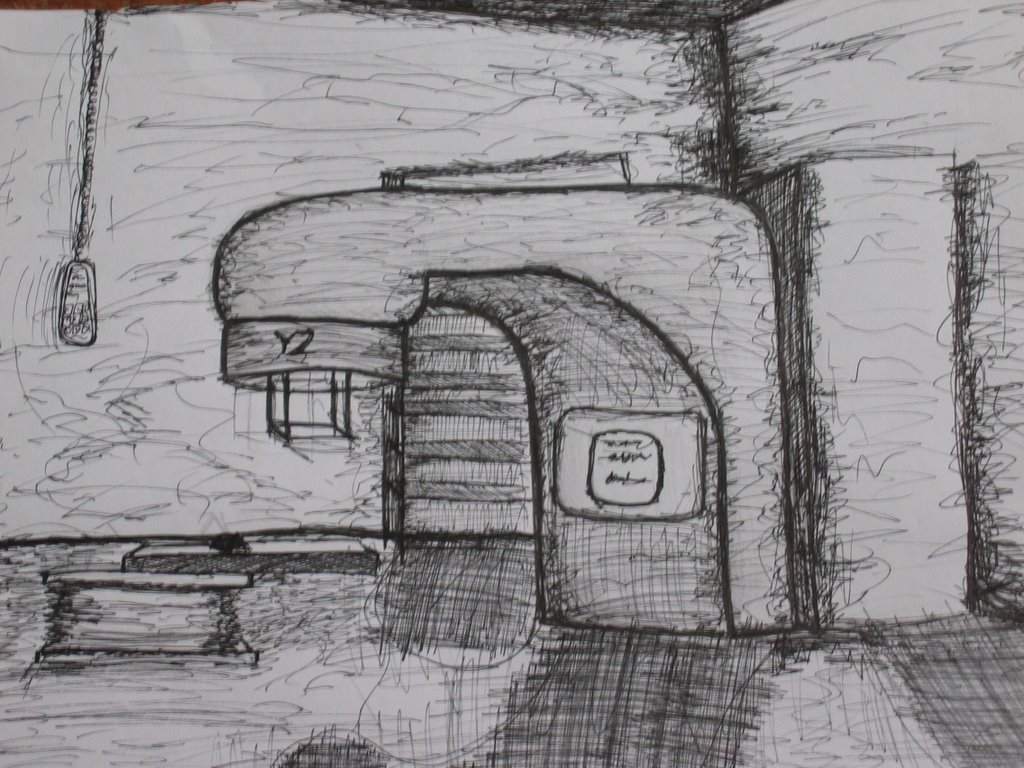
Joel, who has come to at least half the sessions with me, also brought the radiologists a present, a drawing he did over the weekend, from memory, of the second machine, viz:
Robyn and Peter will cook risotto for us tonight. And yesterday, when the temperature soared above 40, Paul's mother came and stood for hours in our sunny living room ironing right down to the bottom of the laundry baskets. At one point, it was so hot she moved the ironing board into the bathroom where it was slightly cooler. And it's not as if Jean doesn't have her own health problems. This was an act of love indeed: if ironing can save me, I'll live to be a hundred.
So I've finished the radiotherapy; Suzanne doesn't want to see me for nine months; and I think I heard Mitchell utter a cautious sentence yesterday with the word 'cure' in it. I'd give anything to wind back the clock again and listen properly. There are five more years of daily Tamoxifen tablets and monthly Triptorelin injections before he's finished with me, but in any case, I knew after my surgery that my prognosis would be good. Everything's gone smoothly; I've been treated beautifully; and my chances — and they are nothing but chances now — are good. The future looks bright.
I feel dreadful.
I'm a mess of sentiment and emotion. Margot came to the door yesterday afternoon and I fell into her arms sobbing. I started to cry all over the mohair rug today, and even more when Joel put his arm around me and laughed with me. I know I am not alone, too. This afternoon as I was joking with Janine and Barbara at my last session, my mother told me there was an old man in the waiting room, looking frail and holding his head in his hand as he cried quietly. And I saw a young woman in her twenties looking grey and drawn with her healthy, anxious partner looking at me in disbelief as I walked out smiling and joking and saying goodbye. (I still don't really look sick.)
The word I use to myself most often these days is 'overwhelmed'. It takes many forms, but today I keep thinking of the wonder of the body and what it can do. I've had a cluster of abnormal cells develop into a tumour that moved beyond the milk duct but no further into the lymph system. This milk duct also fed the child who was born of another extraordinary division of cells, who is now able to draw a picture of the machine that has helped cleanse me of any stray aberrant ones.
I'm pretty sure that if my case had been more serious, I would have been less willing and able to write about it. In almost every sentence I've written, I've been conscious that my case has been relatively mild. But it's been miraculous, all the same.
Perhaps strangest of all, on such a momentous day, after a sleepless night, I've had a good idea about how to structure the chapters in the Garter book. I've been just chipping away at this project over the last week or so for a few hours in the morning, and think I have found a way to establish different writing registers within the book.
Now ... OK, tomorrow ... it's time to turn attention back to the Piers Plowman essay, and to the re-submission of our big ARC grant. This is going to be pretty terrible, as we had polished and tuned every last detail this year, and now we want to make some changes to the scope of the project, which will affect every paragraph, every budget line, every hyphen-break. Oh well. At least I have my health.
Subscribe to:
Posts (Atom)

 Posts


