2016

I've kept this blog, on and off, since 2006. In 2015 I used it to chart daily encounters, images, thoughts and feelings about volcanic basalt/bluestone in Melbourne and Victoria, especially in the first part of the year. I plan to write a book provisionally titled Bluestone: An Emotional History, about human uses of and feelings for bluestone. But I am also working on quite a few other projects and a big grant application, especially now I am on research leave. I'm working mostly from home, then, for six months, and will need online sociability for company!


Monday, January 12, 2015

My Year with Bluestone: The Old Morgue

Yesterday we took the ferry from Southbank over to Williamstown: a beautiful ride down river past the docks and under the Bolte and West Gate Bridges. There are bluestone sites a-plenty here in the old town, and I will have to go back another time. But here's a taster.

In 1859 the busy city of Williamstown (main port for Victorian goldfields) established a morgue at the end of Gem Pier, where our ferry docked. The plan was that the remains of autopsies and mortuary procedures would be washed away at the end of the pier, and the fishes would do the cleaning up... But apparently this became a little unsavoury and in 1873 the building was taken down, bluestone by bluestone, and reconstructed a few blocks away in Ann St. It was used until 1925.


As you can see from this last photograph, it's not an active tourist site, though you can book a tour with the local heritage guides, which I will do in March. It's part of an enormous marine precinct, with a little museum, and if you walk down further on the dock you come to the berth of the Sea Shepherd. The little morgue is small and very unmonumental, in comparison to many bluestone structures. The low roof is also striking, as bluestone is often associated with gothic style in this period.

I touched the stone and tried to think about death and its mysteries. But the historian in me was mostly thinking about the effort and the decision taken to move the morgue, but keep the same building. Was it a heritage question? They clearly didn't need any larger building. And because there are bluestone quarries in the area, you wouldn't think the stone would be in very short supply.

I looked it up when I got home. One website said the morgue was moved because it was becoming too much of a tourist destination! An excess of affect, then. And as many of the heritage sites we visited reminded us, the stones themselves were "hewn" by convicts, who slept at night on the big prison hulks anchored in Hobsons Bay. This will be a common theme of much of the bluestone building in and around Melbourne.

I also found a site that offered late night ghost tours of the morgue. Apparently it is haunted (of course!) by a young girl who just might grab your arm in the dark....


Saturday, January 10, 2015

My Year with Bluestone ... will observe weekends

So while the inspiration for My Year with Bluestone came from the indefatigable Philip Thiel, who blogged every day without fail for each of the six(?) years of his various daily blog projects, I'm working in a different environment, one that has been concerned, almost from its very first post, with the nature of the world of humanities research and the contexts in which it is supported and publicised in Australia.

Over the eight years since then, I've struggled, like most academics, to make sense of our workload, in a context where one's work is never finished. We send essays off; they come back for revisions; and more revisions; and copy-editing (if we're lucky); and proof-reading. Our grants and books go through thousands of iterations. The email in-tray is always full. Our work -- our teaching, supervision, writing, advising, policy-making -- hardly ever reaches moments of final closure.

As I contemplate my return to work on Monday after a few weeks' annual leave (in which I have worked on reducing my email, starting the bluestone blog project and also started reading and thinking about my next essay), I'm thinking that while I may blog on the weekends, as I am doing now, I won't be adding to the bluestone blog archive. Last year I announced I wouldn't be emailing back and forwards in my big research group over the weekends, and restraining the compulsion to blog everyday on the Bluestone is part of the same pattern.

That is, I am trying to order my life a little.  I'm giving myself this year to write the bluestone book, and the blog is already helping immensely in making me realise the things I don't know, and need to think about. Declaring I will write the book this year is a way of giving myself a deadline for it (I will be writing a sample chapter to send to prospective publisher in the next few months), but it's only one of the projects I'm working on this year. And so I am going to pace myself with it, and not kid myself that I can work on all the things, all at once.


Friday, January 09, 2015

My Year with Bluestone: Cemetery Gatehouse and Foliate Heads

The Melbourne General Cemetery was not the city's first, but was established in 1852. The current gatehouse was rebuilt in 1934-5, using materials from two other demolished entrance buildings dating from the 1850s.


So, nearly one hundred years after the gatehouse was first constructed, bluestone was still the preferred stone of choice. I imagine the original building was more gothic in style (something to check). 

There also a sweet little two-sided waiting area as you come through the main gates on College Crescent.

On either side of one of the gates, we found two foliate heads. These are both carved in sandstone, a stone that is much softer and more appropriate for any kind of carving, let alone detailed figurative work like these: 


I guess these are part of the "not-bluestone" part of my history: where the functional, sturdy bluestone gives way to but also supports the warmer sandstone used for trims and carvings. The woman seems to have Victorian-style ringlets...

And finally, also framed or backgrounded by bluestone, a notice about flowers and candles they haven't bothered to translate.

Thursday, January 08, 2015

My Year with Bluestone: Elvis's Birthday

When I used to live in North Carlton, I walked through the cemetery every morning, and in the old days (the last few years) when I used to ride to work, I would sometimes cycle along its paths. It's on highish ground, surrounded by low houses and parklands, and to the east you can look right across the suburbs towards the Dandenongs.

It is of course like a little city: its own roads, avenues, grand street frontages, ghettoes and slums.

But one of the most extraordinary monuments is that which was assembled in honour of Elvis Presley in 1977.  It was opened by 'Johnny O"Keefe.'  On anniversaries of Elvis's birth (today) and death, I have often seen people laying fresh flowers or bringing tape recorders or guitars and playing soft music.

I have enlisted Paul into this project, and his hi-res photos will appear in the book, but here are my quick snaps.


The astute observer will point out that the actual monument is not bluestone at all but conventional black marble or granite (note to self: do quick course in stone identification), and as we wandered around the cemetery we realised it's only the older nineteenth-century tombs that are based on bluestone (more on this in another post). But the grotto that surrounds the monument is made of very uneven bluestone rocks, stuck together with cement, and at several points, the cement has been dribbled down to resemble limestone stalactites. 
For the first time I noticed there is another similar grotto (without memorial) on the other side of a big bluestone mausoleum (again, for another post). We took many, many photos of bluestone tombs and buildings today: I am going to have no trouble finding images to post each day this year. 

But here is indubitably a place of pilgrimage. Not many people there today, but we saw some laying fresh flowers, and placing cards. And while I don't have a photograph to prove it, as we were standing by the memorial, an old, bright red car cruised by. At the wheel, a man wearing a large plastic Elvis wig, dark glasses, and a bright orange leopard-skin shirt or jacket. Too fast to photograph. He drove around a bit but didn't stop to get out. I said "beautiful" to one woman who was laying pink and red carnations, and carefully arranging some red glittery butterflies, and a picture of Elvis in a plastic wrapper, but she didn't reply. Her husband (?) stood behind her, also without speaking, and a daughter (?) with high ponytail and white rhinestone boots sat quietly on the park bench and watched. 

There's a neat blog by Mark Holsworth on Melbourne shrines, that remarks on Melbourne's propensity for shrines to those who never visited here. Holsworth also comments that the Melbourne cemetery shrine is "the only officially approved Memorial to Elvis Presley outside Graceland in Memphis."


Wednesday, January 07, 2015

My Year with Bluestone: Memorials (1); and Questions (1) about book structure

Along the Merri Creek path there are various memorials and markers. Here are three very similar ones, all from 1985, and all using a huge boulder of local stone.


But here is a more recent marker from the same path along the Merri Creek, less commemorative and more instructional or indicative in nature. Not only are the graphics quite different, even quite cute (cute dog and cute snake, while the "carry out rubbish" makes this inner-urban park seem like a wilderness campsite) but the stone is markedly different, both in shape, orientation and quality. 


This contrast provokes me to start thinking about how I am going to organise my book. Topographically? a chapter about the Merri Creek. Thematically? a chapter about memorials. Chronologically? a chapter about historical styles? Politically? I suspect this marker isn't made from local bluestone at all, but from the Chinese bluestone Melbourne increasingly uses to preserve its local heritage styling.

Tuesday, January 06, 2015

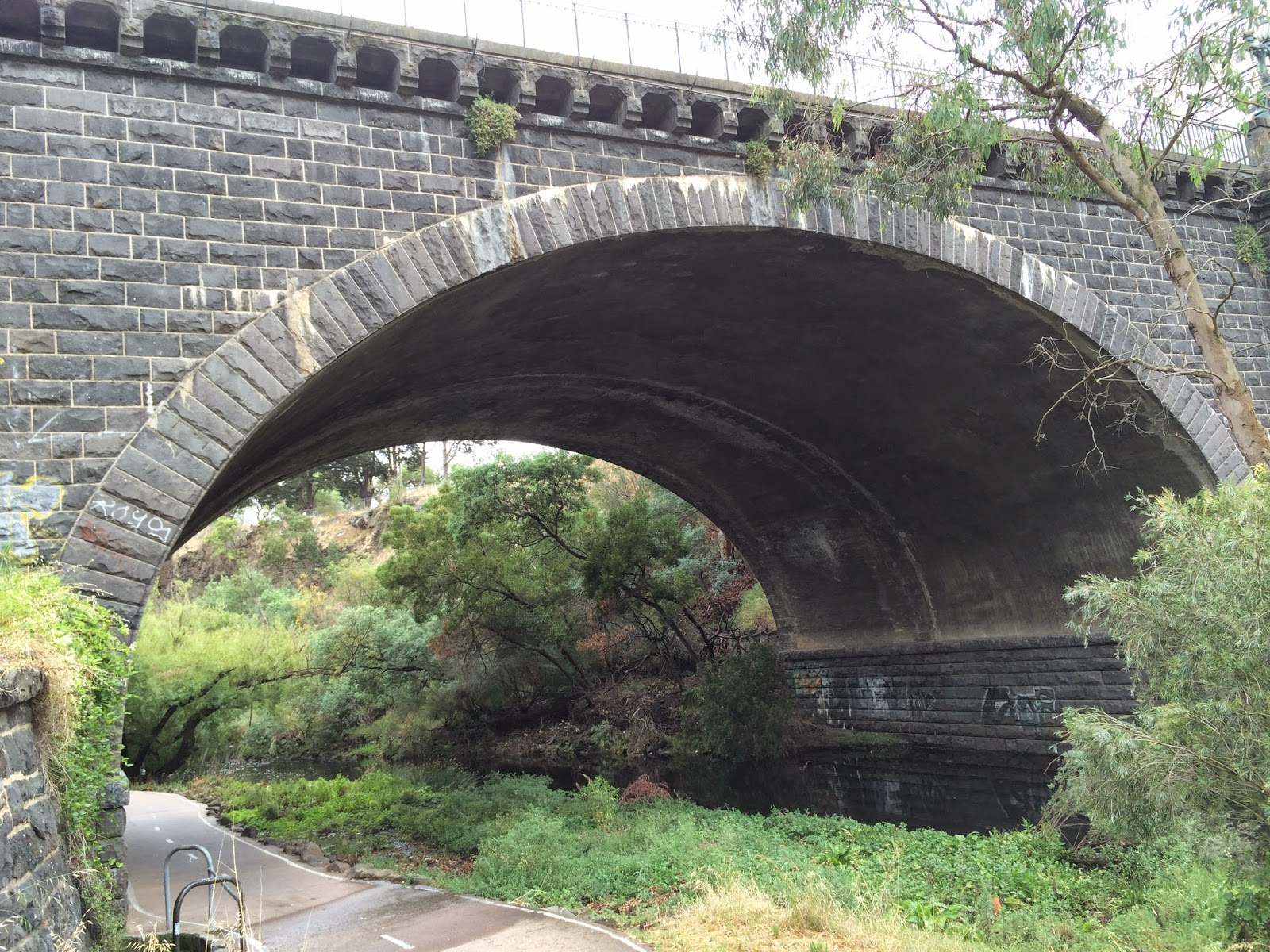
My Year with Bluestone: Bridge over the Merri at Heidelberg Rd and "a most stupid man"

The second of the two bluestone bridges on one of my regular walks along the Merri runs along Heidelberg Road. The bridge is one of the oldest stone bridges in Melbourne, according to the wonderful Encyclopedia of Melbourne, edited by Andrew Brown-May and Shurlee Swain, a book that is becoming a constant companion for this project. Ah, and I see it is also online and searchable: wonderful!!

The Heidelberg Rd bridge was built, according to a Darebin local history, between 1849 and 1852. But there is an article in The Argus of 11 June, 1868 that describes this "very substantial bluestone structure" replacing the old wooden bridge. Unlike the bridge I posted about yesterday, this is a single span bridge, made entirely of bluestone.


And here is an older photograph from road level:


I need to do some work on my architectural vocabulary to describe the fanciness along the top of the bridge. 

I have also just now spend a funny hour googling this bridge and finding all sorts of websites and documents online: local histories and other sites that will make this year's bluestone project easier, though the pdfs are often quite hard to read, and I will of course also spend time -- or ask Helen, my wonderful research assistant on this project -- to spend time, in the libraries. Local histories tell me Heidelberg road was the first to be built leading out of the city of Melbourne; and that there was a flurry of activity mid-century after the colony of Victoria became financially independent of New South Wales.

The best affective moment comes from a report to the Victorian parliament of 1852 from the committee on Roads and Bridges, with transcripts of interviews with various officials. I've just scanned quickly, but this is my favourite exchange.  Robert Hoddle, the city's surveyor, is called before the committee of December 4, 1851. (One of Melbourne's main thoroughfares is named after Hoddle; he laid out the city's distinctive grid plan in 1837.) His answer to question 116 is beautifully candid.

114. Q. Have you employed any person you have faith in, to lay out the roads? A. I have faith in all the gentlemen I employ; but the laying out of roads is the most difficult part of a Surveyor's duty.
115. Q. Is it not necessary that they should understand it? A. I invariably select the most intelligent for this work.
116. Q. As in the case of Kilmore? A. You could not have selected a more unfortunate example, for the Surveyor there showed himself a most stupid man. 
There is something completely charming about this candour. Faith is crucial, but stupidity is damning, and even engineers and surveyors and builders bring an affective charge to their work.

Monday, January 05, 2015

My Year with Bluestone: High St Bridge, Clifton Hill

One of my walks/runs along the Merri Creek I call the "nine bridge walk": I usually only think of this number when I am running home and counting my way back. Some of the bridges are low crossings made of wood, where I sometimes pause and on either side and watch the waters meander — or rush, if it has been raining — towards me; and then away from me on the other side as they head down to join the Yarra river at Dights Falls; other bridges are bricked and embanked railway crossings I pass beneath. Two are magnificent bluestone bridges. This one carries High St from Clifton Hill up into Northcote: it was build of bluestone and local brick in 1875.


And here is a photograph from 1892.


And here is a close up of where bluestone and brick meet.

Underneath the bridge, along the creek path, the bluestone is covered in graffiti and tags.

There's a wide ledge that sometimes shelters the homeless: I've sometimes walked by and seen a swag on the ledge.


As a sign of the times, though, I did one day walk past here without the camera and saw a middle-aged man practising his climbing techniques, clinging on for dear life, all of half a metre above the ledge, to the uneven protusions of bluestone.


Sunday, January 04, 2015

My Year with Bluestone: returning to the labyrinth

I went back to the labyrinth this morning to take some of my own photos. It had rained overnight after two very hot days and the creek smelled of fragrant eucalyptus. The labyrinth sits between the path and a cliff.


Close to the entrance is a sign, surrounded by bluestones. It respects Wurundjeri custodianship and invokes ancient, Biblical and new age discourse, concluding with a slightly strained inverted subjunctive. 

Here is the pock-marked bubbled basalt block that marks your first turn in the labyrinth.


And here is the rough, very irregularly shaped rock that is the first one you pass on your right as you enter.


And here, as if in answer to my desire to trace our affective relationship with bluestone, is the smooth square rock I talked about two days ago, on the left as you enter, but on your right as you emerge, having walked the labyrinth, on which someone has carefully scattered birdseed.


A form of homage? Just this stone and no others. At the very least, a sign that someone else has come to walk this labyrinth and make connections with the creek and its inhabitants.

Saturday, January 03, 2015

Daily pleasures


I see and touch bluestone everyday, and clearly I am not the only one!  Alison posted on my facebook page today: 

Lovely book project! And bluestone - such a huge part of the daily pleasures, for me, of living in Fitzroy: sometimes I pat it as i walk past, sometimes I just like to rest my hand on it... I vividly remember the keynote given at your Hearts of Stone event a few years ago (Jeffrey Cohen?), which was so brilliant on affect and matter and stone....
A few people -- well, Melbournians -- have responded in this way when I mention this project. It truly does feel like the local stone (as sandstone is to Sydney, I think). And indeed, the project takes much inspiration from Jeffrey Cohen's work on stone. My project will be much more local, and even incidental than his, but I cannot wait to read his new book, out in a few months: https://www.upress.umn.edu/book-division/books/stone

We have written together on fire, and will be sharing a panel on the elements at the London Chaucer conference in July with Sophia Wilson and Hetta Howes. We have not worked on stone together, but I'm sure his book will be a guiding spirit to this project. 

Friday, January 02, 2015

Merri Creek Labyrinth

It's the second day of the New Year. High temperatures are predicted, so I decided to go for my walk early in the day. But I don't leave the house until after 11. I'm recovering from a broken arm and my shoulder and neck are hurting. Nevertheless, I manage to run about 2 km and then walk as far as the Bluestone labyrinth along the Merri Creek, constructed by a community group around 2001, according to a Cretan design.  It's not a puzzle, but you are invited to walk around its winding track. Perhaps there will be healing benefits, according to one of the notices. I head off, trying to focus on my breathing, counting 10 breaths then starting again,  and  feeling the rhythm of my footsteps,  and observing the bluestone cobs that have been used to indicate the paths.  There are all kinds of  plants and weeds growing up between the bluestones,  and tan bark  has been laid along the path.  the sun beats down and  I try to  feel the heat come through into my aching bones and muscles. After a while I get a bit dizzy, in the confusing counterpoint of breathing, counting, walking, turning, and trying to observe the stones. I reach the centre,  face the sun, and take a deep breath before turning out again. On the way out it is easier to observe the difference between the stones. Some are almost perfectly square, and I realise they will have been taken from laneways and kerbstones around the city.  Others  are more chunky and irregular in shape. Then I notice a rectangular stone that is  marked all over  with little holes where the  boiling, bubbling rock has been cooled suddenly in water.  One more turn  and I am out.  I turn and stand at the entrance again. On my right, where you turn to enter the labyrinth, is one of the most irregular shaped rocks, jagged and pointy, and covered with the white traces of lichen. On my left is one of the smoothest square blocks. The symbolism is obvious: you enter feeling ragged and jagged and uneven and you emerge smooth, even and serene. As you enter, the bubbled rock is your first obstacle: turn right here...

I start my walk home, feeling overheated and as if I have walked too far. Then I have an idea. My plan this year is to write a book on the affective history of bluestone in Melbourne and Victoria. I had always planned to blog my progress on the book as I go, so this is the first installment for 2015. But then I recalled the brilliant work of Philip Thiel, who for several years kept a series of wonderful blogs: mini entries each year: "A Year with Lemons", "A Year of Kissing People", "A Year of Stopping." What if I could do the same thing with bluestone, charting my encounters with this very characteristic Melbourne stone I walk on and past and through every day?

Well, let's not promise to do it every day. But let's see what happens. So set up your feeds, kids, and we'll see how we go.