2016

I've kept this blog, on and off, since 2006. In 2015 I used it to chart daily encounters, images, thoughts and feelings about volcanic basalt/bluestone in Melbourne and Victoria, especially in the first part of the year. I plan to write a book provisionally titled Bluestone: An Emotional History, about human uses of and feelings for bluestone. But I am also working on quite a few other projects and a big grant application, especially now I am on research leave. I'm working mostly from home, then, for six months, and will need online sociability for company!


Monday, February 18, 2013

A Windy Day

So most of the snow has melted, and the skies were clear and bright today. But the wind!  It was below freezing, and the wind itself was certainly making it feel colder. We had a big agenda today, and did most of it, but it was a struggle, as always, to get up when the alarm rang. Paul had finished an artilce and I had finished the introduction to a special issue of a journal, and we were up late to send them off.

Joel made breakfast with the astonishingly rich and juicy blackberries we are eating in the middle of winter; and we headed out. We rode the subway down to 86th, then walked across Central Park, just south of the Jacqueline Onassis reservoir. Lots of folks running the circuit. I've found it is possible ot run, even when there is snow lining the track, but your hands, ears and face do get very cold. Running in the cold wind would have been pretty nasty on the lungs, I would think.

We were at the Guggenheim by 10.30. I'd seen the name Kandinsky advertised, but in fact this was just a tiny exhibition off the side, of his work between 1911 and 1913. The rest was the work of the post-war Japanese collective, Gutai: some wonderfully inventive works. And what an amazingly beautiful building it is. As you walk down and around, it's amazing to think how much space and light there is around each work. I couldn't help wondering whether the little inner wall would meet modern health and safety standards: it felt just a little low and easy to fall over...  But one of the great things about exhibitions here is that you just go in, start at one end of the spiral and move at your own pace, but in the one direction. So in a group, you don't have to keep checking where the others are: they are either ahead of you or behind...

We then walked back over to Lexington and got the subway down to Astor Place, then walked through Washington Square to the Blue Note jazz cafe for brunch, with a sextet from the Juilliard school. Joel recognised the bass player as having toured Australia with Terence Blanchard last year; and the pianist, Jahann Sweet, is someone he has seen on YouTube. Not a great lunch, but washed down with a mimosa, and some really nice playing, all around the music of Charles Mingus.

After this we headed out into the wind again, and walked quite a few blocks over to Roosevelt Park, where we had read there were some Chinese New Year festivities on; and indeed, we caught the last stages of a procession, complete with long dragons, lions, lots of floats sponsored by community groups, fire twirlers, martial arts demonstrations, and some dancing girls, wearing high heels, very short sparkled blue and silver costumes, long plaits and tassels. Over the parade, people were letting off little crackers, and tossing bunches of little sparkles and streamers. As we walked away, we saw a couple of the dancing girls, their cheerful smiles fading to grimaces and tears as they succumbed to the bitter cold and wind. We also saw a little puddle in the road, filled with coloured tissues, streamers, foils and fragments of colour.

Feeling pretty confident of my navigational skills, even though my phone had run out of battery and we had no map, we wandered back through Little Italy, looking for a decent cup of coffee and a little cafe. Lots of restaurants, but we eventually found a little cafe where we shared a couple of canoli and I had a goodly strong coffee. It takes ages, every time you sit down or get up again, to put on or take off coats, scarves, gloves and hats. But it's worth having all this stuff on when you head off out into the wind again. We were going to head up to the Strand, and again, I was navigating us ok, but then I found the NYU bookshop and I nipped in to pick up Carolyn Dinshaw's How Soon Is Now, which is essential reading for the last chapter of the book I am writing with Tom, who will be here in just over a week. So the writing goes on. 

Saturday, February 09, 2013

The Wintry Mix

We've been here nearly a week now, and have settled into a little routine. We have to set the alarm or we would sleep in through the dark and quiet. We make the coffee, experiment with different cereals, and then struggle with the tiny shower and compare methods of avoiding the cling of the plastic shower curtain....  Paul and I head to the computers and check the night's emails before getting to work. It's been a bit slow, but the introduction to my special issue of Exemplaria is coming along nicely now. I'm planning to finish it in a few days, if possible. Joel reads, or explores youtube on the ipad, or plays piano, and sometimes heads out for a walk with the new camera.

After lunch some or all of us head out for another walk or an expedition. On Wednesday I went down to NYU with Joel and picked up my ID card, which means I can browse the library's terrific online holdings from home, if I don't want to spend the day in the library. We also wandered over to Little Italy and found a terrible cappuccino and a magnificent canoli in a little cafe. Most nights we are heading out to hear some jazz. The last two times, at the Dizzy's at the Lincoln Centre, and at the Blue Note, you get just the one set while you eat an average pub-style dinner. But the music has been excellent. It's great having a piano in the apartment. When Joel feels inspired after the previous evening's concert, he plays well and freely. But it's a bit clangy, and needs a tune, and he says it makes playing scales and doing technical work rather difficult. That's the story, anyway.

Today the news is full of the impending storm. It's already started snowing, and they are threatening up to eight inches by this time tomorrow. But before then, it's the "wintry mix" of snow, sleet and rain. By Sunday it will be sunny and bright. It's hard to know how it will affect what we do today. We were planning to go to MOMA this afternoon as it's free admission after 4.00 on Friday. We'll see how that goes.  Right now, back to my intro.

Sunday, February 03, 2013

The First Day

The day kind of started at 4.30 this morning: the jetlagged brain leaps into action and has to be forcibly restrained with slow deep breathing and sheer determination to keep the eyes closed and the body horizontal. I was still awake, I think, around 6.00 but the next thing I knew Joel was knocking on the door saying it was 12.30.

The flight over was very smooth, though Qantas is now clearly economising on food and luxuries. I missed my chamomile tea... But what is normally the worst part of the flight — sitting bolt upright, desperate with twitchy aching legs on a domestic connection from LAX across to the east coast — is much easier and faster when it's done in a big 747. Travelling with family is so much easier than travelling on your own. Who cares if a son or partner climbs over you in the middle of the night? Not me. And can you leave your bags in the airport when you go to the loo? Yes you can!

Our apartment here, which we found through sabbaticalhomes.com, is fabulous. Up on 108th and Broadway, the streets are much quieter than the theatre district where we stayed in 2009. We have a small bedroom, a small bathroom and small kitchen, but a decent sized loungeroom and separate study. There are three desks for working at. And there is an upright piano. Our landlord is a guitarist and music professor. It's also spotlessly clean. I will sort out photos soon, I hope. We're up on the second floor, and the apartment is an L-shape, built around central courtyards and inlets. Not a huge amount of natural light, but it's warm and cosy. It's good being in a place with books and music.

We are also travelling with a friend who's with us for a few days, visiting her daughter who's here on exchange but who has become quite unwell. So our joys are tempered by concern for this other family.

The three of us have just walked down Riverside Park for thirty blocks. I love that we can walk uninterrupted by the traffic lights at the end of every block, and I can see myself running there (with hat, gloves, and long pants, of course). We walked about thirty blocks, then stopped for black bean soup and quesadillas, before Paul and I came back, walking along Broadway, to meet our landlord's friend and pick up the second key. Joel is off wandering on his own, re-orienting himself.

It's now 4.30 pm, and I think we might now head out again, to get the last of the afternoon light and do some shopping for food: apparently the markets around here are pretty good. I have borrowed Robyn's fabulous coat; I have a fleecy hat my mother made me years ago; I have fleecy gloves I bought in New York in 2005; and I have a lambswool scarf I bought in Edinburgh in 2000. It's 29º or -2º. Not too windy; no rain; no snow. So with the right gear, it's nothing but bracingly pleasant.

Here's our building:http://streeteasy.com/nyc/building/the-manchester

I'll see if I can link to googlemaps to show where we are:
http://maps.google.com.au/maps?q=255+W+108th+St,+New+York,+10025,+United+States&hl=en&ll=40.795358,-73.961935&spn=0.042041,0.057421&geocode=FQOabgIdClqX-w&hnear=255+W+108th+St,+New+York,+10025,+United+States&t=m&z=14:


Monday, January 28, 2013

Pre-departure

It's Monday night. On Friday morning we say our last goodbyes to all the animals, leave the house in the care of our trusty house-sitters, and head to the airport for three months away.

I am planning to return to this blog to track our adventures once we get going, and to meditate on the idea of "leave" but an important part of the pre-departure travail is to keep track of hours and days as they pass so quickly, and as we lurch from task to task.

Among those tasks are these:


  • tidy house to reasonable degree and make sure all instructions for animals and all the odd little ways of an old house are reasonably intelligible
  • stock up on chicken, fish, and cat food
  • organise ESTA application for Joel (done!)
  • print out all itineraries, letters of invitation, details of access to our New York apartment so they will actually let us in to the United States
  • work out what books and papers to print and take
  • make back up of computer files on ancient hard drive; and thank goodness for Dropbox
  • take delivery (tomorrow?) of new laptop; and arrange IT consultation to upload software (Wednesday?). Ancient hard drive now says it will take 56 hours to copy 10,000 items. That can't possibly be right.
  • read two more PhD chapters; do two more performance appraisals; have two more delightful lunches; have two more research team meetings; review two videos of self talking about the research centre; introduce three research students to lovely replacement supervisor
  • write a book proposal and a special issue proposal
  • write (i.e. start) introduction to special issue of journal
  • finish Chapter Six (these two may not be done by Friday, I now realise)
  • have meetings with two research groups
  • washing, ironing, packing, finding of gloves
  • keep study tidy so I don't panic
  • buy new travel bag? Maybe not. I went on line at Hunts, and found a lovely soft leather one for $1500. I don't think so!!
Not all these things will get done. But many of them *have* to get done. But for once, heading off on leave, I'm not taking a huge big research project with me, so the archive isn't a problem. I'll be finishing a book, though, and writing up two papers (one already in draft form); and then when I return early May I'll have another three months before I start teaching, so I think it will be a productive leave. I'm already missing my home, and don't like to think what it will be like to put Joel on the plane to come home at the end of February. But still. You know what they say. It's an adventure; and travelling en famille is such a rare pleasure for us. We'll all feel better when we get on the plane...

Thursday, October 18, 2012

Six Years Down

It is six years, almost to the day, since I went under the knife. I have just had my annual mammogram, ultrasound and review with my wonderful surgeon. I wrote about Suzanne a lot in the first months (here, here and here, especially) : she was a revelation to me, about how a brilliant technician could also be a calm, intelligent leader in the workplace. From my various encounters this morning, it's clear her staff adore her as much as I do.

What's the upshot, then, six years down the track?

  • No sign of recurrence
  • No swelling in arm (lymphoedema)
  • No desire for reconstructive surgery (Suzanne asks each year, but I'm not at all ashamed of my scar and the deep indentation along one side of one breast)
  • Some residual pain (from radiotherapy: it will be lifelong, but I'm now under instruction not to  use the really heavy weights at the gym)
  • Bone density normal
  • Menopause ...
  • No medications (nothing; currently not taking anything of any kind; no vitamins; nothing)
  • Weight under control (obesity is an indicator for breast cancer)
  • Reduced alcohol consumption (alcohol is a BIG indicator for breast cancer)
  • Some residual feeling that powers of concentration aren't what they were, but a gradual realisation that this might be picking up now I am no longer taking tamoxifen
  • Reminder of sense that I am glad I did not have to go through chemotherapy or mastectomy (both of which have very long recovery times and difficult after-effects)
So all in all, I reckon that's about as good as it gets. I am very conscious that compared to many women I have got off relatively lightly, and also received (and been able to pay for) consistently superlative and compassionate health care. 

Last night I was talking with a friend who'd had a much rarer, more difficult blood cancer. We agreed that everytime you go in for these tests you kind of hold your breath for the day before. I guess eventually it gets easier. For me the five year mark last year was really important as it meant the end of the daily tablets and the monthly injections. This one seems to mark the beginning of a new phase, as every year out I am absorbed back into the general population with only an average risk of breast cancer.

So good am I feeling about this, and so much am I enjoying blogging again, I am even going to change my profile text in the next day or so.

Cheers!!


Tuesday, October 16, 2012

Teaching the History of Emotions


This year the Faculty of Arts introduced its controversial new coursework program. Until this year, the PhD in Arts at Melbourne was taught entirely by research thesis, externally assessed by examiners who had no contact with the student. Over the first year of their enrolment, our new students now must enrol in one of seven 2-hour fortnightly workshops, for which they write a 5000 word essay; and two intensive units, for which they write essays of 2500 words each. This program has not met with universal acclaim. It's taking students and staff a while to get used to coursework that seems like an extra imposition that is assessed, and yet doesn't really "count" in the final assessment for the PhD.

Nevertheless, on we go. I have co-taught both a workshop ("Researching Texts") which will finish this Friday after two semesters; and an elective, "The History of Emotions." The latter finished today. We taught it in four three-hour sessions ("we" being me and Stephanie and Sarah, the two post-doctoral fellows in the Centre for the History of Emotions). Penelope, our new Education and Outreach officer, also audited the subject: her experience with psychology and art was invaluable at several strategic points in discussion.

Both subjects have been, for me, a delight to teach. I've not done that much collaborative teaching, really (not having medieval colleagues makes it tricky, for one thing), and I really enjoyed sharing ideas and responsibility for organisation and for leading discussion.

The students for both subjects ranged extremely widely. Most of the students in Researching Texts were from literature (not just English) and creative writing and cultural studies and performance. The students in the History of Emotions were even more diverse. None from literature; quite a few from history; but also archaeology, philosophy, cinema studies, linguistics, etc. Another student audited. Someone working on C15 Italian texts; another on C17 witchcraft pamphlets; another on C17 Italian art; but mostly modern topics: Heidegger; the films of Sofia Coppola and rococco style; the social phenomena of languages as they die out; the politics and representation of Somalian piracy; a history of the animal rights movement in Australia, etc. So, about as diverse a bunch as you could find. Some were candid about choosing the intensive sheerly for timetable reasons. Some had very little understanding of what the field of the history of emotions involved. But through sheer intellectual curiosity, and academic courtesy, and the impending sense of having to write an essay within a month, by the time of our last session this morning, when we asked them all to bring along an object, a text, an image, an idea for their essay, all but one (who is preoccupied with other deadlines at the moment)  had been able to think their way quite quickly into this very diverse and complex field. They spoke eloquently and passionately. It was clear that wherever they had begun, many of them had found some really interesting places to go with this material. I'm really looking forward to reading their essays.

We didn't want to overburden them with reading, as you'll see from the course outline below. That's one of the limitations of an intensive subject. Anyone wanting to familiarise themself with the field could do worse than start with Susan Matt and with Jan Plamper's interview, rightly becoming a canonical standard in the field.

Of all the things we read, my favorite was the Monique Scheer essay. Scheer uses Bourdieu and practice theory to build a model of "emotional practice" (based on the habitus) that is attentive to somatic as well as cognitive practices, and to social context without being overly restrictive or programmatic. There's more work for me to do on this, but I think this has the potential, as Scheer says, to bypass the quarrel between emotion and affect. The essay was a little divisive, though. The Heideggerian, the archaeologist and the cinema studies student liked it as much as I did; others less familiar with Bourdieu found it harder work.

I'm currently thinking about two episodes in Chaucer and Malory where grown men (Absolon and Lancelot) are described as weeping like a child who has been beaten. The concept of emotional practice will, I think, help me think about the relation between these very different narrative contexts and the relative similarity of body language (both are kneeling, and both cannot speak after they weep) and the quasi-proverbial nature of the simile. So that's good.

Tomorrow I teach Book IV of Troilus and Criseyde; on Friday we have our "graduation" from Researching Texts, complete with a workshop from an actor who'll help them with presentation skills (relaxation, breathing, speaking). Next week, two lectures on John Forbes and Book V of the Troilus. That is the class that has been bringing astonishing baked goods for morning tea all semester. Wonder what they'll produce for our picnic lunch after class?

History of Emotions PhD Elective, 2012


An elective convened by Stephanie Downes, Sarah Randles and Stephanie Trigg, meeting in four 3-hour sessions between October 8 and 16.

Assessment: One 2500 word essay on a topic of your choice, due Monday 5th November.

Readings  will be posted on the LMS site from Wednesday, 3rd October. A longer bibliography will be made available at the first session.


Session One: Monday, October 8, 11.00 – 2.00.
Room 210 (Old Arts)

Bring your lunch, and we’ll supply tea/coffee.


Part One: Orientation to the History of Emotions: From Heart to Head

Questions for discussion:
·      What are our sources for the ‘history of emotions’?
·      What do emotions ‘do’?
·      How do we write the history of emotions?

Readings:

Matt, Susan. ‘Current Emotion Research in History: Or, Doing History from the Inside Out,’ Emotion Review 3 (2011): 117-124.

Plamper, Jan. ‘The History of Emotions: An Interview with William Reddy, Barbara Rosenwein, and Peter Stearns,’ History and Theory 49 (May 2010): 237-65.

Part Two: The History of Tears

Questions for discussion:
·      What is the relation between emotion and tears?
·      Do tears have a history?
·      Is this history gendered?

Readings:

Thomas Dixon, ‘The Tears of Mr Justice Willes,’ Journal of Victorian Culture (2011): 1-23.

Lyn A. Blanchfield, ‘Prologomenon: Considerations of Weeping and Sincerity in the Middle Ages,’ Crying in the Middle Ages: Tears of History, ed. Elina Gertsman (New York: Routledge, 2012), xxi-xxx.


* * * * * * * *


Session Two: Tuesday, October 9, 1.15 – 4.15
Room 209 (Old Arts)

We’ll supply tea/coffee and cake.

Part One: Private Grief

Readings:

Freud, ‘Mourning and Melancholia’ (1917), in The Standard Edition of the Complete Psychological Works, Vol. 14, 237-258. http://www.barondecharlus.com/uploads/2/7/8/8/2788245/freud_-_mourning_and_melancholia.pdf

Shakespeare, Hamlet (any edition).

Melancholia, dir. Lars von Trier (2012). Check out this YouTube trailer http://www.youtube.com/watch?v=wzD0U841LRM; and we’ll try and screen selected scenes.

Gail Kern Paster, ‘The pith and marrow of our attribute: dialogue of skin and skull in Hamlet and Holbein’s The Ambassadors,’ Textual Practice 23.2 (2009): 247-265.


Part Two: Public Shame

Readings:


Sara Ahmed, ‘Shame Before Others,’ in The Cultural Politics of Emotion (New York: Routledge, 2004).


* * * * * * * *

Session Three: Monday, October 15, 11.00 – 2.00
 Potter Gallery
(luncheon arrangements to be determined)

Part One: Emotions and Images

Heather Gaunt of the Potter Gallery will lead discussions of selected works in the Potter collection

Part Two: Emotions and Objects

Guy Fletcher, ‘Sentimental Value,’ The Journal of Value Inquiry 43 (2009): 55-65.

Roberta Gilchrist, ‘Magic for the Dead? The Archaeology of Magic in Late Medieval Burials,’ Medieval Archaology 52 (2008): 119-159.


* * * * * * *

Session Four: Tuesday, October 16th, 9.00 – 12.00

Part One: Where to from here?

Bring a text, an object, an idea, a source, a problem, and be prepared to introduce it for a few minutes.

Part Two: Research directions

Theorising happiness, and other emotions…

Reading:
Monique Scheer, ‘Are Emotions a Kind of Practice (and is that what makes them have a history)?’ History and Theory 51 (2012): 193-220.


Sunday, September 30, 2012

Solo Improvisation - 30.9.12


This is Joel playing to a tiny video recorder when the house was otherwise empty this afternoon. This is how he is getting through the rigours of his VCE year. He sometimes struggles to balance the need to practise and play so he can do good auditions for music degrees at the end of the year, with the need to study and revise for his upcoming final exams.

My mother and I watched this together tonight — my parents came up and drove me to a church in North Balwyn where I talked about the history of emotions project to their Sunday evening group — and Mum asked him if he was happy when he played. "Oh yes," he said in a heartfelt manner. Apart from the performer's anxieties and frustrations with wanting to do better. Still, I do think that fifteen minutes of utterly improvised and passionate music is no small feat at age 17.

Wednesday, September 26, 2012

Evolutionary Music

Sometimes, and especially after dinner in the evenings, Joel will mooch towards the piano and start to play. At this end of the day it will usually be free improvisation. He will simply start to play, sometimes after a moment's thought; sometimes immediately.

Tonight, as the kettle boiled for tea, he produced three minutes of accelerating, deepening, bubbling, rippling sounds, ending abruptly with a "click" as the water boiled.

But then, having made the tea, as his parents stretched out on the couch and a comfy chair, a new magic began.

Over a complex rhythmic bass pattern, the variations in the right hand began, overlapping and layering with the richest sounds. The lid was open and the sound filled the room. Waves and waves of echoing, woody piano patterns emerged, lit up by occasional moments of dissonance against the resonance and harmonic patterning. The rhythms were sharp and powerful; the melodies sweet and lyrical.

We are watching David Attenborough's Life on Earth (two weeks ago he'd improvised around the theme music), and had just watched the episode in which the Australian marsupials starred: all those tiny blind creatures crawling toward the pouch. I could not help but contrast the complex life-form before me: full of teenage anxiety, conflict and doubt (someone he knows, of his age, has recently died after enduring depression), yet producing this confident, emotional music. I'd look over and see his head bent down, Keith Jarrett style, as he rocked and swayed into the music. I'd catch his father's eye, and we'd raise our eyebrows together in mutual wonder.

When he'd finished (my tea was almost cold before I drank it), he spoke about the music, how he was experimenting in the right hand with melodies oriented around a semitone higher than the dominant key in the bass; how he was thinking about Attenborough's world: the earth as planet and as eco-system, with all its life forms.

I have a hundred mundane tasks to complete, but don't know where to begin with any of them.

Thursday, July 12, 2012

Little updates

Wow, I could hardly remember how to sign in: it's been so long.

What's been happening? Here's a YouTube version of my book launch:

http://www.youtube.com/watch?v=Oh5MApCdxuc


And here's a link to my fundraising page for my Very First Ever Fun Run this Sunday. I am going to run 10 kilometres around the Botanical Gardens and back and forth along the river, and am fund-raising for Amnesty. Donations have ranged between $2 and $500, and I am hoping to make it to $2000:

http://runmelbourne.everydayhero.com.au/stephanie_trigg

So I have been training.

I have been battling a thousand cumbersome university administration matters. Nothing is straightforward; there is usually no one who will do it for you; and it is never done right the first time. It gets bounced around from office to office then sits on someone's desk for three weeks. Sigh. Groan.

I am also writing. I am late sending my paper to the discussion group I'll be part of at the Chaucer conference in two weeks. Will get back to it in a second.

I have also committed myself to so many talks I lose track of them.

I've also discovered there is something like a 100% mark-up on the Australian distributor's price of my book.

I am also the mother of a 17 year old VCE student. I'm not going to say any more about that...

Wednesday, June 20, 2012

End of the story

It started as just a chapter in a proposed book on medievalism and gender, but Simon encouraged me to ditch the other chapters and just work on this chapter on the Order of the Garter. Even back then I knew I wanted to focus on the myth, whether true or no, of the Garter's origin in a embarrassing incident involving a piece of underwear dropping off in public. And I knew I didn't want to write a 'straight' historical narrative. Anyway, like most books it took rather longer than I thought to fall into place. I had more material than I could really use, and left out lots of things, but to no great regret so far.

No reviews yet, and I await them with predictable apprehension.

In the meantime, there is much pleasure to be had from finishing this big book. For a start, its gorgeous cover: the wicked leering glance of the Prince Regent awaking the Spirit of Brighton, wearing nothing but pretty shoes, pretty wings and his Garter regalia. After all, it must be worn at all times: you're naked without it.

There is pleasure from celebrating its launching. I don't know why I didn't have a launch for the Chaucer book, but I made up for that by having two for this one. One in Sydney, and one in Melbourne. Both were enjoyable, though I was somewhat nervous before the Melbourne one and then hardly slept at all the night after. So much adrenaline racing around.

But I was buoyed by the warmth of family and friends. What a luxury to be surrounded by people who understand what it means to write a book like this. My mother phoned a few days ago to say
how much she was enjoying reading it. So that's good.


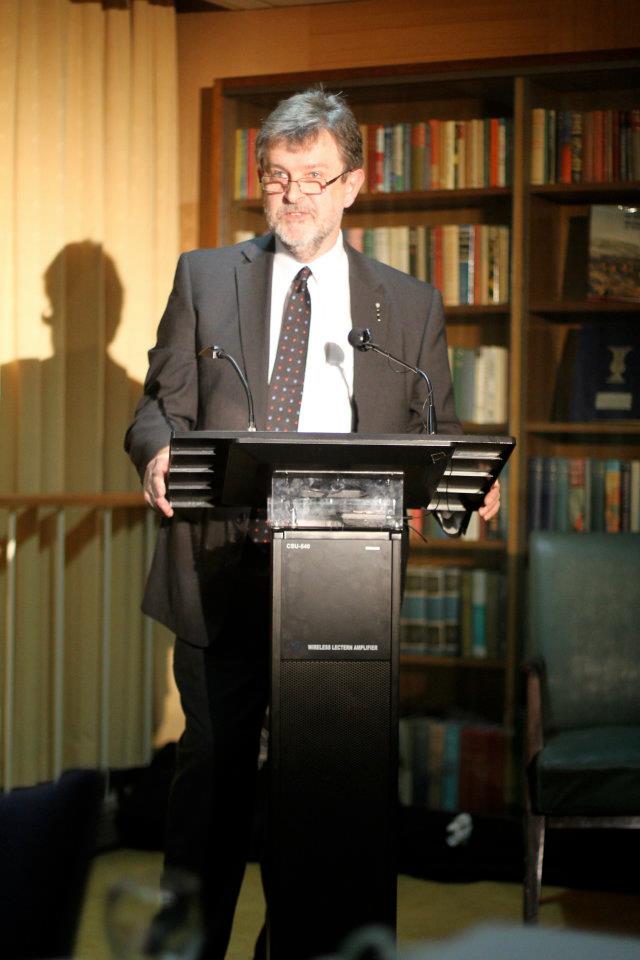
I am having trouble sorting these pictures from the Melbourne launch into sequence, and they may appear a little odd in the final formatting, but this is me and Deirdre Coleman, my dear friend and colleague, who was the MC. And the book in Melbourne was launched by Brien Hallett. Brien and I were undergraduates together, and as you can see, he is now the Usher of the Black Rod in the Senate. Black Rod's a Garter official dating from the fourteenth century, so there were some lovely circles and loops being tied that night. 

I have also done a little publicity for the book. Penn started a "vulgar board about the Order of the Garter" on Pinterest; I wrote a piece for the Daily Beast; and did a little QandA for The Age. Readers of Humanities Researcher provided support, community, distraction and inspiration. You read chapters, you provided images and ideas, and I came here often as refuge. Thank you.