I suspect that's the longest gap between postings since I began the blog. It's partly a result of the busyness of Christmas; partly the increasing need for naps and sleep-ins as the radiotherapy comes to the pointy end. Something new, and not altogether pleasant seems to be happening in the relationship between work and living and reading and writing, too.
A quick health update, first: I have five more big radiotherapy sessions to go, then eight shorter, lighter doses to be directed along the scar line. I was measured up for these before Christmas. I feared going into the CT tunnel again (I always forget till it's too late that I hate enclosed spaces and low ceilings), but this was more low tech. Lie on your side, Michael will draw on you with blue pencil, and then Andy will come in and make a tracing onto a transparent sheet then take a photo (I almost said polaroid, but it looked suspiciously like my own digital camera).
My breast is starting to resemble a roasted beetroot: pink and brown in patches, within a sharply delineated area which probably looks square on the infra-red grid when I'm lying down, but which on the body is curved into odd angles. I'm assured this will all start to fade as soon as the treatment ends, but right now it feels pretty much like sunburn. I woke in the middle of the night last night saying to myself, 'I don't know what to do with it!', where to put it in the bed, as if it were a detachable appendage. I had also been dreaming that Kylie Minogue paid me a visitation and delivered some wise words I was not able to remember. So I got up, had a chamomile tea, then went back to bed and slept in till 10.00. We had breakfast in bed (cereal, raspberries and blackberries) and made a plan for the day. Paul went to work in the garden and at his computer; Joel set to work on his new animation; and I lingered on reading Garrison Keilor's Love Me, about a Minnesota man who moves to New York and fulfils his dream working at the New Yorker until he develops writer's block and the magazine is taken over by the Mafia.
I'm sometimes asked what I'm doing, how my own writing is going, how much trash TV I'm watching. In fact, I spend a lot of time in the garden, feeding the goldfish and admiring their babies, and talking to Mima, my fifteen-year-old tabby. We have become very close over the last few months and have had many happy conversations on the couch in the afternoon sun or walking around the new garden and its fishponds. No trash TV: we are working our way through the West Wing on DVD in the evenings, and watching some very short cricket matches in the afternoon. I'm as keen for a 5-0 Ashes victory as the next woman, but it'd be good to see the English team defer their inevitable implosion till they get on the plane to go home, so that they could at least take the game into the fourth day.
But there's no real reason why I shouldn't be writing. I'm alert and sprightly enough for good portions of each day, and can find energy to blog, and read, and chat (and cook: Siena cakes, florentines and chocolate brandy balls for Christmas). But we have eaten dinner the last two nights with dear friends, all of whom are scholars and writers, and I listened with a kind of detached interest about their various writing projects. My own writing seems miles away. As far as work is concerned, I am just able to keep up with the little tasks that need to be done: ask Maria to organise a little seminar in honour of David Wallace for late February; arrange my travel plans to get to Adelaide earlier in the month; set aside some time for a meeting of our grant team next weekend to start re-writing our application for the ARC.
I guess the energy for writing will return when the current radiation fatigue recedes. When I think about it though, I didn't actually do much writing in 2006. I finished a big essay in February, and wrote a conference paper in July that I was very pleased with, but the rest of the year seemed to disappear in committees, the Headstart training program, and then the flurry of starting work on the NCS program committee then handing it over to Ruth and David and John when I became ill. I don't think I'm too worried about not writing. It's normally a source of great pleasure for me, and I have several projects on the boil, individual and collaborative, that I'm still intrigued by. Fortunately, I had lots of things in the pipeline (I've corrected three sets of proofs since I've been sick), so I'll still look ok on paper for a while yet, in terms of the research productivity that is such a preoccupation for us all now.
It's just the nature of academic life, that you can never let it go completely. I'm far from complaining: this is the other side of the coin that makes it possible to take time out for daily treatment and comprehensive sick leave without any threat to my job security or income. I'll just have to trust my own instincts, that the desire to write will return when I have something to say, and when I can read anything other than fiction for more than half an hour before falling asleep.
It's New Year's Eve today. We would normally be in the third day of cooking and cleaning and preparing for a big party, but prudently decided not to go ahead this year. We're going to open a special bottle of wine, climb up on the roof to watch the fireworks, and have an early night. Health and Happiness in the New Year to all.
Sunday, December 31, 2006


Thursday, December 14, 2006
The day I finally get the point about the chocolates...
Three posts ago I was noting the custom of leaving little chocolates in the lockers where we keep our gowns at the radiotherapy clinic, on the last day of treatment. The same day the assistants apologised for taking so long to get the machinery and the flat bed into place. It takes two or three of them to position me and the machinery properly: I have to lie flat with my arms outstretched behind my head grasping a bar, while also relaxing my right arm so it doesn't get in the way of the machine as it beams its rays up at me from below my right side. Sometimes I have to let go and bring my arm back then rotate it again with their help until I am positioned correctly. They then move the bed back and up and check and double-check the height and placing of the rays, reading the measurements back to each other and checking the infra-red grid on my body. The machine has to be programmed for its two positions before it can begin. (I guess they treat the breast from either side in this way to avoid a daily blast of radiation directly into the lungs and rib cage: this way it kind of passes through the breast. I'll never breast-feed again on that side, but hey...) Sometimes it takes a while to get all these measurements and co-ordinates perfect, and Sue apologised for the time it was taking. That's fine, I said, in my cheery good-patient voice: take your time and get it right. It's just that sometimes patients are feeling a little frail, they explained, and don't like being jerked around. I couldn't understand why you would mind waiting for these people to do their job properly on your behalf.
But now, I get it! I'm a third of the way through my treatments (12 down, 21 to go), and yesterday the thought of getting my cramping menstrual body up into this position was pretty forbidding. I asked if they could possibly treat me while I lay in the foetal position, and they very sympathetically said no and helped me up on the bed anyway, with just the right amount of understanding that acknowledged my unwillingness without letting me spiral into self-pity. So I understood that day that sometimes you don't want to be jerked around on the machine. And that some days a piece of cheap chocolate left by someone who's gone through it and come through is exactly what you want.
I'm very conscious that my case is a minor one, and that my residual good health is seeing me through this process with minimal damage. So far: a slightly re-shaped breast; two long scars that are healing well; some residual numbness under my arm that may or may not heal; a little rash from the radiotherapy that is irritating but treatable, and which will start to heal after January 17th. There are some more serious hormonal side-effects that will kick in after the new year, but really, nothing exceptional. I know that in comparison to a thousand other possibilities and conjunctions of illness, treatment, side-effects, social and emotional and financial contexts, my situation is excellent.
All the same, there's no doubt that emotions and impressions are heightened; and that I am experiencing an unaccustomed fragility that is sometimes emotional, sometimes social, sometimes intellectual. I can write, now, of a moment over a month ago, when I finally looked at myself in the mirror before a shower, with all the bandages and surgical tape removed for the first time. All I could see were the two long black lines of my surgical scars. Images from Caroline Walker Bynum's essays on the wounded, perforated and open bodies of Christ and the saints flashed through my mind and I started to black out; and caught hold of the bathroom bench just in time. I looked carefully at one of the scars today and was surprised to find it much shorter than I'd remembered it. How long is a scar? How deep is a wound?
But now, I get it! I'm a third of the way through my treatments (12 down, 21 to go), and yesterday the thought of getting my cramping menstrual body up into this position was pretty forbidding. I asked if they could possibly treat me while I lay in the foetal position, and they very sympathetically said no and helped me up on the bed anyway, with just the right amount of understanding that acknowledged my unwillingness without letting me spiral into self-pity. So I understood that day that sometimes you don't want to be jerked around on the machine. And that some days a piece of cheap chocolate left by someone who's gone through it and come through is exactly what you want.
I'm very conscious that my case is a minor one, and that my residual good health is seeing me through this process with minimal damage. So far: a slightly re-shaped breast; two long scars that are healing well; some residual numbness under my arm that may or may not heal; a little rash from the radiotherapy that is irritating but treatable, and which will start to heal after January 17th. There are some more serious hormonal side-effects that will kick in after the new year, but really, nothing exceptional. I know that in comparison to a thousand other possibilities and conjunctions of illness, treatment, side-effects, social and emotional and financial contexts, my situation is excellent.
All the same, there's no doubt that emotions and impressions are heightened; and that I am experiencing an unaccustomed fragility that is sometimes emotional, sometimes social, sometimes intellectual. I can write, now, of a moment over a month ago, when I finally looked at myself in the mirror before a shower, with all the bandages and surgical tape removed for the first time. All I could see were the two long black lines of my surgical scars. Images from Caroline Walker Bynum's essays on the wounded, perforated and open bodies of Christ and the saints flashed through my mind and I started to black out; and caught hold of the bathroom bench just in time. I looked carefully at one of the scars today and was surprised to find it much shorter than I'd remembered it. How long is a scar? How deep is a wound?
Monday, December 11, 2006
An uncomfortable piece of surgery
Waking up to breakfast radio this morning, and the announcement of a conversation, later in the morning, with a speaker 'who's had a biography out'. Nasty...
Thursday, December 07, 2006
How we teach and write now
This is a question for all you literary/historical types.
For the little essay I’m writing on Piers Plowman, I’m reading around and thinking about the question of authorial and narrative voice, and thinking about the ways we can help students think about the voices in the poem. I’ve been reading David Benson’s wonderful book, Public Piers Plowman: Modern Scholarship and Late Medieval English Culture, and am pleased to find he has been thinking about medieval public culture (using Habermas) in ways I know I am going to find useful when I eventually get around to working on the project and grant application whose progress I began this blog in order to chart. Oh well. Sigh. Being sick just means I have to go slower, is all.
I was very struck by this passage, on page 74:
“Piers is an interactive text meant to be applied to its readers’ lives. As such, it somewhat resembles a modern newspaper, which different readers will use differently, each one finding information or advice to suit his or her own needs.”
I find this a very evocative analogy, because it chimes with my slowly-germinating idea about the pre-history of public or mass culture in a manuscript era. I suspect, too, it is the kind of thing we often say when we are teaching, as a short-hand guide to students trying to make sense of unfamiliar works. And because it takes the form of an analogy, it is different from Kittredge’s famously ahistorical pronouncement about Chaucer’s Troilus and Criseyde as the first novel.
But there is perhaps an interesting issue to be teased out here, about the way we use analogy or other similar devices to explain the effect of medieval or pre-modern texts. I don't mean to raise the hoary methodological issue of "presentism". I'm interested in the rhetorical status of this kind of remark in what is a profoundly historicist study, after all.
Perhaps it's a question about the relation between pedagogy and scholarship. Have we tended to censor this kind of remark out of our writing, when we might use it freely in the classroom? Is that self-censorship lightening up? What do people think? How do we see the relation between our teaching and our writing?
Now that I think about it, I am reminded of a comment one of my students made after our discussions of Troilus and Criseyde this semester: he was a little disturbed by the easy and familiar way we were talking about the characters' personalities and sexualities. It's hard *not* to do this when you are teaching, though I would almost certainly not write in that way. Hypocrisy? Or respect for the differences between spoken and written discourse, between informal and formal contexts, between pedagogy and scholarship?
n.b. A few people have commented that they have found it hard to post a comment on this blog. I'm not sure why that would be, but if you experience technical difficulties, and would like to post, please follow the links to my homepage and email me (and signal whether you'd like me to post on your behalf).
For the little essay I’m writing on Piers Plowman, I’m reading around and thinking about the question of authorial and narrative voice, and thinking about the ways we can help students think about the voices in the poem. I’ve been reading David Benson’s wonderful book, Public Piers Plowman: Modern Scholarship and Late Medieval English Culture, and am pleased to find he has been thinking about medieval public culture (using Habermas) in ways I know I am going to find useful when I eventually get around to working on the project and grant application whose progress I began this blog in order to chart. Oh well. Sigh. Being sick just means I have to go slower, is all.
I was very struck by this passage, on page 74:
“Piers is an interactive text meant to be applied to its readers’ lives. As such, it somewhat resembles a modern newspaper, which different readers will use differently, each one finding information or advice to suit his or her own needs.”
I find this a very evocative analogy, because it chimes with my slowly-germinating idea about the pre-history of public or mass culture in a manuscript era. I suspect, too, it is the kind of thing we often say when we are teaching, as a short-hand guide to students trying to make sense of unfamiliar works. And because it takes the form of an analogy, it is different from Kittredge’s famously ahistorical pronouncement about Chaucer’s Troilus and Criseyde as the first novel.
But there is perhaps an interesting issue to be teased out here, about the way we use analogy or other similar devices to explain the effect of medieval or pre-modern texts. I don't mean to raise the hoary methodological issue of "presentism". I'm interested in the rhetorical status of this kind of remark in what is a profoundly historicist study, after all.
Perhaps it's a question about the relation between pedagogy and scholarship. Have we tended to censor this kind of remark out of our writing, when we might use it freely in the classroom? Is that self-censorship lightening up? What do people think? How do we see the relation between our teaching and our writing?
Now that I think about it, I am reminded of a comment one of my students made after our discussions of Troilus and Criseyde this semester: he was a little disturbed by the easy and familiar way we were talking about the characters' personalities and sexualities. It's hard *not* to do this when you are teaching, though I would almost certainly not write in that way. Hypocrisy? Or respect for the differences between spoken and written discourse, between informal and formal contexts, between pedagogy and scholarship?
n.b. A few people have commented that they have found it hard to post a comment on this blog. I'm not sure why that would be, but if you experience technical difficulties, and would like to post, please follow the links to my homepage and email me (and signal whether you'd like me to post on your behalf).
Personal, professional and reproductive lives
Anyone reading this blog with an interest in how we combine the professional and the personal aspects of our life might want to check out Wednesday's post from Ampersand Duck, an articulate, but ultimately very sad tale about the tensions between a professional and a reproductive career. Alert: anyone who is currently pregnant and feeling vulnerable should probably skip this one.
Tuesday, December 05, 2006
Notes from the radiotherapy clinic
I'm settling into the routine of daily radiotherapy. The technicians are fantastically efficient, and if I get there on time, I wait only a minute or two before I'm called through to change into my gown, and then summoned into the treatment room. They mark me up (using the tattoos as a guide) under the infra-red light (I think that's what it is: same technology that reads the barcode on my library card), then leave me as the big machine moves back and forth over me for a short silent burst of radiation on each side of the 'treatment area'. It takes perhaps ten minutes in all, and then I'm free to go.
I'm not there long enough really to meet other patients, but it's easy to see that we are all at different stages. Some are inpatients in dressing-gowns and slippers, some are in wheelchairs, some are accompanied by relatives, some of the women are wearing scarves and beanies. One elderly woman was helped to her taxi by a kindly driver. I'm still sprightly enough: it's too soon, I was told yesterday, to start feeling the fatigue that is the common side-effect of treatment. No one looks particularly gaunt or ill, though; and this is reassuring to me. Someone came in yesterday and updated us on the cricket scores from Adelaide. Today I leafed through the brochure from the wig company.
On the way to the treatment rooms, there is a bank of about seventy little cupboards, each with the name of a patient on the door. Inside is the gown we wear to treatment (so clever, to save the washing and I guess to keep it a little familiar), and yesterday, there were two mini chocolate bars. I asked who had put them there and was told it had become a convention at this hospital. A woman who was delighted to have finished her treatment left a treat for everyone else, and it has become customary. There was another there today. I haven't eaten them yet; and have started stockpiling them in the 'fridge. Something about respect for these gifts, perhaps, in not consuming them instantly?
I'm not there long enough really to meet other patients, but it's easy to see that we are all at different stages. Some are inpatients in dressing-gowns and slippers, some are in wheelchairs, some are accompanied by relatives, some of the women are wearing scarves and beanies. One elderly woman was helped to her taxi by a kindly driver. I'm still sprightly enough: it's too soon, I was told yesterday, to start feeling the fatigue that is the common side-effect of treatment. No one looks particularly gaunt or ill, though; and this is reassuring to me. Someone came in yesterday and updated us on the cricket scores from Adelaide. Today I leafed through the brochure from the wig company.
On the way to the treatment rooms, there is a bank of about seventy little cupboards, each with the name of a patient on the door. Inside is the gown we wear to treatment (so clever, to save the washing and I guess to keep it a little familiar), and yesterday, there were two mini chocolate bars. I asked who had put them there and was told it had become a convention at this hospital. A woman who was delighted to have finished her treatment left a treat for everyone else, and it has become customary. There was another there today. I haven't eaten them yet; and have started stockpiling them in the 'fridge. Something about respect for these gifts, perhaps, in not consuming them instantly?
Monday, December 04, 2006
And we like sheep... Ritual, music, summer (part two)
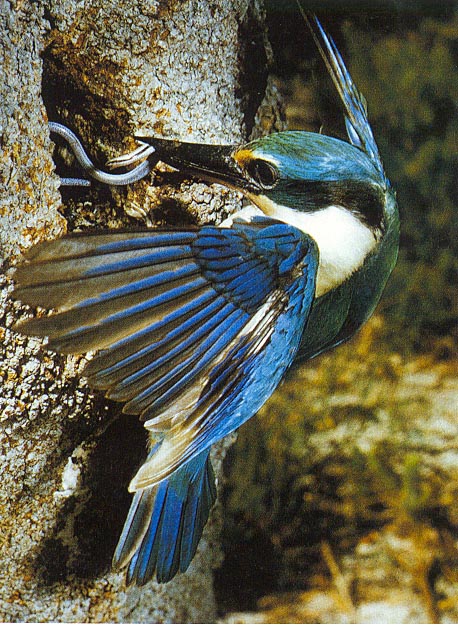 Over the last eight days, three radically different musical events. Last Saturday, the annual Return of the Sacred Kingfisher festival at Ceres, the environmental park twenty minutes' walk north along the Merri Creek. The festival celebrates the seasonal return of this beautiful migratory bird; but also its return to the creek after twenty or more years' work cleaning up the water of most of its pollutants, reclaiming the tip site for Ceres, and replanting the creek banks with native grasses and trees (yes, we miss the willows, but are learning to live without such "exotics", as they are called).
 In some years the festival is well-funded; and it has won several awards. We've seen crowds of school kids taking part in processions of birds and insects; fire dancers and elaborate silhouette shows; ritual narratives of environmental destruction and renewal; political narratives of refugees and colonisation; massed community choirs; dance classes teaching us the "kingfisher boogie". One memorable year we saw a group of Aboriginal dancers and performers enacting Wurundjeri life prior to the invasion of the First Fleet (the local bicycle club, streaming white sails on flags above their bikes as they rode across the grassy playing area). Some way to the side of the campfire, not really part of the main action, we saw one man — fleetingly, unheralded — become a kangaroo. Sprawled on the grass, he twitched his head, and moved a paw to his ear. It lasted perhaps three seconds; and then the Fleet landed.
This year's festival had received no budget, and was thus a much more modest affair, though still structured around a cleansing rite of renewal and rebirth through fire. A singer conducted the crowd of several hundred people in a complex three-part harmony of the lullaby the farmer sings to Babe, "If I had words". As the sun went down, I thought I saw a flash of blue fire disappear into a tree. A visitation from the presiding spirit?
The next day Liz took me to a concert from the Gloriana choir: a program of unfamiliar and diverse music, including works by Brahms and Schumann, Anne Boyd's hypnotic As I crossed a bridge of dreams, and a Mass for Four Choirs by Charpentier. There were only about thirty singers, so that made only about one or two person per musical line. They sang beautifully, in an old bluestone church in Fitzroy. Liz found the Charpentier transcending; and I could see how it might be, but on this, my first hearing, it felt more like listening to an elaborate, absorbing conversation among friends. Heather invited us for champagne on the grass outside the church afterwards, in the last of the afternoon sun as the bluestone shadows lengthened.
Yesterday, another community event: a People's Messiah, performed by amateur choir and orchestra in a white Georgian church in the city, with four excellent soloists and an invitation to bring or hire a score and sing the choruses. I had gone to my first sing-along Messiah this time last year in St Louis, walking through the cold air to Graham Chapel at Washington University, and sung with some very serious and committed singers. The people around me started talking to each other only as we left; they were all singers in choirs of various kinds. Yesterday's performance was of more mixed musical quality; but people sang gladly under some spirited conducting; and an update on the cricket after the break: Australia was 3/187, so we could lift up our heads (o we gates!). Joel and I went with another family, but they left at interval: Lucien was tired, and Robbie had a bit of trouble working out why everyone was singing about liking sheep. This will become a family classic, I think: it's making me smile and chuckle even now. How lovely that translation is, though. The phrase "man of sorrows" has become familiar, but to be "acquainted with grief"? I wonder: is this emotional understatement powerful? or just startling in its unfamiliarity?
Joel and I had afternoon tea at the European: a rhubarb and tamarillo mille feuille that was downright architectural. Imagine cooking rhubarb so it is tender enough to eat, but firm enough to line up in neat geometrical rows and then cover with a crisp rectangle of pastry and then repeat the layers; and to build another little stack of rhubarb logs on the side of the plate. Well fortified, Joel sang snippets of Hallelujahs and sheep and a child being born all the way to the tram.
Sheep? Babe liked them, too.
Thursday, November 30, 2006
Ritual, music, summer (part one)
A few posts ago, I lamented that I would be unable to make the Christmas puddings this year. This would make two years in a row I had missed, for last year we were still in St Louis, and the earnest little beagles at Melbourne airport would never have let them through quarantine. But my father read the blog and thought that this would be something he could help me with. So over the weekend I weighed up the fruit and left it to soak in the beer and brandy, and then two days ago he set to work blanching the almonds and grating the oranges, lemons and carrots (this is a fabulous recipe, with no suet, just butter and piles of fruit), while I measured up the flour and spices. He then stirred the mixture. This was no mean feat, as we made two large puddings, one for Paul's family on Christmas Eve, and one for mine on Christmas Day; and the physical activity of all that grating and stirring would certainly have been a challenge (I have almost complete movement in my arm, but it's still a little weak). But I was pleased to find that with a little encouragement I was able to do something I enjoy, but had thought would be too difficult. It means our family rituals can resume after last year’s abeyance: Glenda will make several dishes of brandy butter (one for Christmas Eve, and one for me to take to my parents); Rod and Trish will bring the customary fresh berries and chocolate dipping sauce. It is a time of such plenty in this country.
Cooking in this way has a strong ritual component that was surely healing for me over the last few days, as the big pots rumbled and steamed in the kitchen. We all stirred the mixture and made a wish, while I debated with Joel the protocols of declaring your wish in public afterwards (we agreed wishes were better kept secret). Watching my father blanch the almonds also took me back to my childhood, learning to cook with my mother and marvelling at the way the hot water could make the milky white nuts slip so easily out of the dirty skins that we could never have peeled away. I also got to use one of my favourite kitchen implements, the tiny grater I keep in the jar with the nutmegs. This is the specific pleasure of precisely the right implement for the job. But there was something else, too: a lingering trace of the exotic quality of spices, and their special requirements and properties (you can throw in an extra handful of apricots or cherries, but you can't mess with half a teaspoon of nutmeg). And a recollection of trying to recall, in other years, a book I read as a child: somewhere, a warm kitchen scene where spices were special and rare, and had to be used carefully because the spice seller wouldn’t be coming to the house for another year. I can’t remember any more than this (how can I possibly hope to recover this book when this is all I can remember of it?), but the kitchen had something of the quality of Marmaduke Scarlett’s kitchen in The Little White Horse. I guess it's too much to hope this rings a bell with anyone?
Cooking in this way has a strong ritual component that was surely healing for me over the last few days, as the big pots rumbled and steamed in the kitchen. We all stirred the mixture and made a wish, while I debated with Joel the protocols of declaring your wish in public afterwards (we agreed wishes were better kept secret). Watching my father blanch the almonds also took me back to my childhood, learning to cook with my mother and marvelling at the way the hot water could make the milky white nuts slip so easily out of the dirty skins that we could never have peeled away. I also got to use one of my favourite kitchen implements, the tiny grater I keep in the jar with the nutmegs. This is the specific pleasure of precisely the right implement for the job. But there was something else, too: a lingering trace of the exotic quality of spices, and their special requirements and properties (you can throw in an extra handful of apricots or cherries, but you can't mess with half a teaspoon of nutmeg). And a recollection of trying to recall, in other years, a book I read as a child: somewhere, a warm kitchen scene where spices were special and rare, and had to be used carefully because the spice seller wouldn’t be coming to the house for another year. I can’t remember any more than this (how can I possibly hope to recover this book when this is all I can remember of it?), but the kitchen had something of the quality of Marmaduke Scarlett’s kitchen in The Little White Horse. I guess it's too much to hope this rings a bell with anyone?
Wednesday, November 22, 2006
It's not just about the statistics...
I met my radiologist on Monday. Michael is younger than Suzanne and Mitchell, but shares the same clarity and compassion that seems to characterise the team at the Mercy. He had also been at the practice meeting about my case. We talked about the clinical trial of the twofold hormone therapies, and the decision not to have chemotherapy. He pulled a little phone/palm-pilot thing from his breast pocket and showed me how it could calculate my chances of recurrence, given the details from the pathology report, and the success of the surgery, my age and general good health. With the standard hormone treatments, chemotherapy would add just 1% to my chances of going the magical ten years without a recurrence. Chemotherapy also brings its own risks of course, including about a 1% chance of developing leukemia later in life. Well, let's be brutally honest here: all the cancer treatments bring unpleasant side effects and risks of various kinds. For example, I will lose about 5% of capacity in one lung over the 33 radiation treatments to come, as that part of the lung becomes scar tissue.
But the medical statistics, truly, are only part of the story. I am slowly realising what an emotional ride this is. Physically, I'm stronger and stronger every day as I wait for the adjuvant treatments to begin. Today I took myself down to the beautiful heated outdoor Fitzroy pool and swam 16 x 50m laps in its crystalline waters under blue skies and warm sun. Well, it's true that some of these were just with the kickboard, but stretching out my arm till it hurts (Michael's expression) is the best way of regaining strength. I still have a few patches along my arm and side where it still feels as if I am wearing a layer of sandpaper under the skin, but it is now just a fine grade, as opposed to the coarse grade that suddenly appeared a few weeks ago when the total numbness started to disappear.
I've had my CT scan and been tattooed (truly: three minuscule dots!), in readiness for the radiotherapy to start next Tuesday. That was fine, but there was a delay the next day when Danielle, the research associate, was ill, and wasn't able to enter me into the database and "randomise" me for the trial. Without this research protocol, the hormone therapy could not begin for another week. The news threw me badly, as I had prepared myself emotionally for this new chemical intervention into the body. I came home (Tash, the nurse, and Mitchell himself had both phoned me but I hadn't checked my mobile for messages), and felt teary and unable to read or do anything much for the rest of the day.
I find I have to pace myself, then, in terms of social interactions. I have not been accustomed to thinking of myself as emotionally frail or fragile, but am finding that the only place I want to be, most days, is at home. My son suggested I think of myself as hibernating while the treatments are going on; and it is one of the most helpful pieces of advice I have been given.
One of the reasons I write so much about the doctors is because I am fascinated with their understanding of professional practice. I am lucky to be in the hands of people who clearly, simply love their jobs. I have never felt rushed, or patronised by them. One time, about a week after surgery, I was in at the clinic having my wounds checked by the nurse, and Suzanne came in to see how I was going. She just stood there quietly and listened to me talk. Then the three of us would sit or stand in silence, and I would think of something else I wanted to say or ask. Suzanne would respond; and then we would all wait quietly a bit longer, and I would think of something else. This happened a few times.
Sometimes I am bright and cheery with the doctors and we converse as professionals, swapping stories about lecturing or research protocols or music (Mitchell is a pianist); other times I am serious and anxious, wanting lots of reassurance. I think I may have something to learn from them about how to supervise students. I don't mean I want to medicalise them! But rather to be more open to listening to the mood that they are in and how they are feeling. It's not just about the body and the statistics; it's not just about the thesis.
Another inspiring model to contemplate is Larry, my tennis coach. (I can see how far I've come physically this last week, as I not only rode my bike for the first time on Sunday; I also had a gentle hit at tennis.) Last year we asked Larry to teach our son to play; and then I started joining in to share the lessons, since I had never learned. Then my partner, who is an excellent player, joined in for coaching tips; and then our neighbour Alan, who introduced us to Larry in the first place, also joined in. So for an hour on Sundays, Larry manages an 11 year old, two 48 year olds (one beginner; one expert), and an 82 year old veteran. Through his own passion for the game, he somehow teaches all of us with grace, wisdom and good humour, tailoring the advice and the level of play for what we all need. He coaches just a few streets from where he grew up, and still lives. There are many, many worse ways to live.
But the medical statistics, truly, are only part of the story. I am slowly realising what an emotional ride this is. Physically, I'm stronger and stronger every day as I wait for the adjuvant treatments to begin. Today I took myself down to the beautiful heated outdoor Fitzroy pool and swam 16 x 50m laps in its crystalline waters under blue skies and warm sun. Well, it's true that some of these were just with the kickboard, but stretching out my arm till it hurts (Michael's expression) is the best way of regaining strength. I still have a few patches along my arm and side where it still feels as if I am wearing a layer of sandpaper under the skin, but it is now just a fine grade, as opposed to the coarse grade that suddenly appeared a few weeks ago when the total numbness started to disappear.
I've had my CT scan and been tattooed (truly: three minuscule dots!), in readiness for the radiotherapy to start next Tuesday. That was fine, but there was a delay the next day when Danielle, the research associate, was ill, and wasn't able to enter me into the database and "randomise" me for the trial. Without this research protocol, the hormone therapy could not begin for another week. The news threw me badly, as I had prepared myself emotionally for this new chemical intervention into the body. I came home (Tash, the nurse, and Mitchell himself had both phoned me but I hadn't checked my mobile for messages), and felt teary and unable to read or do anything much for the rest of the day.
I find I have to pace myself, then, in terms of social interactions. I have not been accustomed to thinking of myself as emotionally frail or fragile, but am finding that the only place I want to be, most days, is at home. My son suggested I think of myself as hibernating while the treatments are going on; and it is one of the most helpful pieces of advice I have been given.
One of the reasons I write so much about the doctors is because I am fascinated with their understanding of professional practice. I am lucky to be in the hands of people who clearly, simply love their jobs. I have never felt rushed, or patronised by them. One time, about a week after surgery, I was in at the clinic having my wounds checked by the nurse, and Suzanne came in to see how I was going. She just stood there quietly and listened to me talk. Then the three of us would sit or stand in silence, and I would think of something else I wanted to say or ask. Suzanne would respond; and then we would all wait quietly a bit longer, and I would think of something else. This happened a few times.
Sometimes I am bright and cheery with the doctors and we converse as professionals, swapping stories about lecturing or research protocols or music (Mitchell is a pianist); other times I am serious and anxious, wanting lots of reassurance. I think I may have something to learn from them about how to supervise students. I don't mean I want to medicalise them! But rather to be more open to listening to the mood that they are in and how they are feeling. It's not just about the body and the statistics; it's not just about the thesis.
Another inspiring model to contemplate is Larry, my tennis coach. (I can see how far I've come physically this last week, as I not only rode my bike for the first time on Sunday; I also had a gentle hit at tennis.) Last year we asked Larry to teach our son to play; and then I started joining in to share the lessons, since I had never learned. Then my partner, who is an excellent player, joined in for coaching tips; and then our neighbour Alan, who introduced us to Larry in the first place, also joined in. So for an hour on Sundays, Larry manages an 11 year old, two 48 year olds (one beginner; one expert), and an 82 year old veteran. Through his own passion for the game, he somehow teaches all of us with grace, wisdom and good humour, tailoring the advice and the level of play for what we all need. He coaches just a few streets from where he grew up, and still lives. There are many, many worse ways to live.
Thursday, November 16, 2006
Don't tell her to "Be positive"
In one of the little brochures that came with the "My Journey" pack put together by the Breast Cancer Network Australia, there is some terrific advice for "Helping a friend or colleague with breast cancer." Some of this seems very locally specific: I doubt that the restorative powers of Tim Tams are recognised in the US, for example; and I can think of many finer ways of introducing the beneficial anti-oxidant properties of the cocoa bean into the body. Mostly the advice is very sensible, and makes even more sense to me now than it did when I first read it. It is just over a month since my official diagnosis (and about seven weeks since I first noticed the incriminating dimple in a hotel bathroom in St Louis). Under the "Things that won't help" section, one suggestion rings with me today. "Don't tell her to 'Be positive'".
Now, this is a tricky one, since it's widely acknowledged that having a positive attitude can make a real difference to one's experience of illness and treatment. A friend of my partner's gave us Norman Cousins' 'Anatomy of an Illness', a classic tale of healing through active collaboration with the physician and positive will power (far more enabling to me than Sontag's 'Illness as Metaphor', since her discussion of cancer now seems rather dated). But it seems that telling someone who is afraid and anxious (ok, I've had a couple of bad days) to "be positive" would be about as useful as telling someone who is depressed to "cheer up". No one has actually said this to me, I should say; just the insistent little voice in my head worrying that I've not been feeling as resilient and positive as I was a few weeks ago.
Yesterday, for example, I didn't go for the daily walk I've prescribed for myself. Well, it *was* hailing on the West Gate bridge, and snowing in the Dandenongs, the far outer suburbs in the mountains to the east (this is spring in the new southern hemisphere of climate change), but I had a day of feeling sorry for myself, and allowing myself to get distracted from my best intentions. This morning I was tempted to stay in bed and read, but after some wise partnerly counselling about the dangers of cocooning myself, I did head off for my walk. I laughed at myself after fifteen minutes, though, realising that I had taken my cocoon with me: two layers of wool under a thick double-lined coat I had bought for a St Louis winter last year; a warm lambswool scarf I had bought in Edinburgh; and knitted gloves. I came home in warm sunshine carrying most of this stuff in my arms, and was able to sit down to fulfil another of the small imperatives I have given myself: to read for at least an hour a day towards an essay I am writing on Piers Plowman.
Along my walk, I was pondering the difficulties of trying to reform and change my life, over the course of my treatment, and in the years to come. I am ready to accept the conventional wisdom and the experience of patients and doctors that cancer can often be a sign to us to re-assess our priorities. So far, I haven't found that I want to throw it all in and take up mushroom-farming: I find merely that I want to re-direct my energies and find a way to streamline the chaos of books, papers, committees, teaching, grants, meetings, emails, letters, forms and databases, to allow more time for the things I love best: reading and writing, for work and pleasure; and music, for pleasure. I could try and manage it all better (I spent far too long the other day looking for a memory stick with a reference on it which I had hidden away somewhere; and ended up writing the reference again from scratch), but I think an even harder challenge will be to become one of those people who says things like "no, I'm sorry, I won't be able to do that". I've done it a few times already over the last few weeks, and of course I survived. I will have to think of these as rehearsals for when I am no longer sick, when I will really need to be stronger about this.
In the meantime, here's a resonant little quotation. The essay I read this morning was Kathryn Kerby-Fulton's "Langland and the Bibliographic Ego", in which she suggests that Langland revised the C version of the poem from an imperfect version of B not because it was the only one he had available, but because it was the version that was already abroad, already in circulation, and the one that most needed correcting and updating. She quotes Pearsall: "The C-reviser seems to have worked piecemeal, outward from certain cores of dissatisfaction, rather than systematically through B from beginning to end."
Working outward from certain cores of dissatisfaction? This seems to me a helpful way of thinking about gradually making some changes. No lightning bolts; no revelations; just the slow work of reformation through reading and writing around certain central cores and clusters of ideas.
Now, this is a tricky one, since it's widely acknowledged that having a positive attitude can make a real difference to one's experience of illness and treatment. A friend of my partner's gave us Norman Cousins' 'Anatomy of an Illness', a classic tale of healing through active collaboration with the physician and positive will power (far more enabling to me than Sontag's 'Illness as Metaphor', since her discussion of cancer now seems rather dated). But it seems that telling someone who is afraid and anxious (ok, I've had a couple of bad days) to "be positive" would be about as useful as telling someone who is depressed to "cheer up". No one has actually said this to me, I should say; just the insistent little voice in my head worrying that I've not been feeling as resilient and positive as I was a few weeks ago.
Yesterday, for example, I didn't go for the daily walk I've prescribed for myself. Well, it *was* hailing on the West Gate bridge, and snowing in the Dandenongs, the far outer suburbs in the mountains to the east (this is spring in the new southern hemisphere of climate change), but I had a day of feeling sorry for myself, and allowing myself to get distracted from my best intentions. This morning I was tempted to stay in bed and read, but after some wise partnerly counselling about the dangers of cocooning myself, I did head off for my walk. I laughed at myself after fifteen minutes, though, realising that I had taken my cocoon with me: two layers of wool under a thick double-lined coat I had bought for a St Louis winter last year; a warm lambswool scarf I had bought in Edinburgh; and knitted gloves. I came home in warm sunshine carrying most of this stuff in my arms, and was able to sit down to fulfil another of the small imperatives I have given myself: to read for at least an hour a day towards an essay I am writing on Piers Plowman.
Along my walk, I was pondering the difficulties of trying to reform and change my life, over the course of my treatment, and in the years to come. I am ready to accept the conventional wisdom and the experience of patients and doctors that cancer can often be a sign to us to re-assess our priorities. So far, I haven't found that I want to throw it all in and take up mushroom-farming: I find merely that I want to re-direct my energies and find a way to streamline the chaos of books, papers, committees, teaching, grants, meetings, emails, letters, forms and databases, to allow more time for the things I love best: reading and writing, for work and pleasure; and music, for pleasure. I could try and manage it all better (I spent far too long the other day looking for a memory stick with a reference on it which I had hidden away somewhere; and ended up writing the reference again from scratch), but I think an even harder challenge will be to become one of those people who says things like "no, I'm sorry, I won't be able to do that". I've done it a few times already over the last few weeks, and of course I survived. I will have to think of these as rehearsals for when I am no longer sick, when I will really need to be stronger about this.
In the meantime, here's a resonant little quotation. The essay I read this morning was Kathryn Kerby-Fulton's "Langland and the Bibliographic Ego", in which she suggests that Langland revised the C version of the poem from an imperfect version of B not because it was the only one he had available, but because it was the version that was already abroad, already in circulation, and the one that most needed correcting and updating. She quotes Pearsall: "The C-reviser seems to have worked piecemeal, outward from certain cores of dissatisfaction, rather than systematically through B from beginning to end."
Working outward from certain cores of dissatisfaction? This seems to me a helpful way of thinking about gradually making some changes. No lightning bolts; no revelations; just the slow work of reformation through reading and writing around certain central cores and clusters of ideas.
Subscribe to:
Posts (Atom)

 Posts
Posts


