Towards the end of my radiotherapy sessions, Kristy told me about a woman also receiving treatment at the same time as me. She'd had chemotherapy and lost all her hair, but would turn up every day looking fabulous: a wig or a hat, make-up, beautiful clothes. Then one day she arrived looking pale and wan, in drab clothes. Kristy asked if she wasn't feeling so well, but she apparently replied in a deadpan voice: "First day back at work."
I can absolutely understand this, as I slowly wind my way back into a fuller programme of work (writing; supervisions; eight lectures; a conference in London; and a research trip over the twelve week semester that starts this week). I'm feeling very wary of slipping into old ways of taking on too much, and don't trust myself to be strong enough to protect myself. There's no doubt I'm over the most difficult parts of my treatment, but while I'm starting to feel physically stronger in lots of ways, it's quite clear to me that I haven't yet finished being sick. In one sense it's lovely to feel some energy returning, but it's so clear to me that I can't return to the same life I was living before September, when the little dimple appeared and called a halt to life in the academic fast lane. I'm almost sorry I don't have some more visible sign of illness to protect me.
This is contradictory, of course: ten days ago I was sitting in a lovely restaurant with my partner and son, my writing collaborator and another dear medievalist friend. We had toured the amazing Werribee Mansion, and were just sitting down to a crisp white tablecloth and local Shadowfax wines, before heading to Torquay beach for the afternoon, and then tea with my parents. All of a sudden, I announced with deep, clear and joyful conviction, that I didn't feel like a sick person anymore. And it's true: I don't. I'm walking along the creek every morning for about forty minutes; and while my right arm is sore after playing tennis on Sunday and trying too hard, too soon, to start working on my serve (the scar under my arm feels pulled and strained today), I was, nevertheless, running around the court, and not feeling too tired by the end.
But I still feel, very clearly, that I haven't finished my recovery. There are still huge and clear limits to my energy levels, especially when it comes to drawing on reserves of emotional and social energy. I feel I have no such reserves any more. I still need a nap most days; I still quickly feel overwhelmed and a little panicky. I'm sure it's not at all like having a nervous breakdown; and yet I do feel as if I have, indeed, lost my nerve. Literally, of course, this is exactly what's happened: I'm still numb and tingly in sections of my arm and shoulder where the nerves were cut as part of the lymph node biopsy. In this case, the bodily metaphor has a literal correlative.
It's difficult to write about this, since I don't want anyone reading this blog to feel they are imposing, or creating difficulties when I have agreed to do things. I am directly responsible, myself, for my health and the careful decisions I've made about teaching and other projects over the next few months; and am only doing things I want to do. So no one needs to worry about that.
The other difficult thing to think about, and it's something I've been very coy about until now, is that I've had to tackle the idea — ok, the fact — of menopause, rather earlier than I was anticipating. Because my tumour had a high rate of responsiveness to oestrogen and progesterone, the recommended treatment is to lock down the body's response to these hormones (this is what the Tamoxifen tablets do). I'm also having the further treatment of monthly injections of a drug that effectively shuts down my ovaries (ovarian ablation is the term here). Menopause came on pretty swiftly: my body gave up its menstrual cycle without a word; and I'm having periodic hot flushes (or 'flashes', as they are called in the US; or 'power surges', if you are feeling confident and strong), but also sometimes cold flashes. Oestrogen, it turns out, helps you regulate your body temperature.
So far, this hasn't actually been too bad, but it's another reason why I feel I've barely begun to process everything that's happened. I haven't finished reading all the cancer-diet books; we only got about a third of the way through Middlemarch; I'm only just beginning to establish the meditation routine I began in December; and I don't yet know how to make the changes I want to make in my life.
Tuesday, February 27, 2007


Friday, February 16, 2007
Conferences, collaboration and koalas
Home again, back at the desk after just over a week away in Adelaide. It was a lovely conference: Lawrence was incredibly lucky with the weather (I see it's going to be 38 there today and 40 both days of the weekend); papers were great; and people were charming. This is a group where I know lots of people, and normally go to heaps of papers and hang out at Simon's bookstand and at morning and afternoon teas. This year it was an abrupt re-immersion into public life after my illness, and it was tough at times. I certainly didn't have the energy to go to papers all day, so had to make some hard choices, and time a nap back at the hotel every day. I found it easier to sit down than stand up, and easier to sit outside in the quiet sun than inside with all the conversational buzz. Since coming out of the slump after radiation therapy a few weeks ago, I'm physically feeling a bit stronger all the time, but am still feeling fragile in lots of ways. One of the symptoms is distress if I can hear too many conversations going on around me. I've always been completely intolerant of hearing two pieces of music at the same time, even in snatches of song or a tiny musical theme on the radio; and this has now extended to conversation.
Long before I was diagnosed, Tom and I had planned to circulate our paper for discussion prior to the conference, and this turned out to be a great idea, as we didn't have to stand up and talk. This is the first finished paper/chapter of the book we are writing on theories of medievalism and its relationship with medieval studies. Rather, Tom spoke for a few minutes; John gave his response (sympathetic, but also opening up some tricky avenues for future thought); and then there was time for a good discussion.
On my way to the paper, I passed a tutorial room and heard a familiar, dulcet voice explaining something. It was clearly a "teaching moment"; and it was also clearly Pavlov's Cat in full, eloquent flight, teaching a summer school. We met up with Paul as planned that night and it was a delight to see her looking so very well: her lovely face animated with conversation.
Adelaide turned on some beautiful restaurants and weather; then Tom and I hired a car and drove a group down to Port Willunga (long stretches of clean sand between magnificent cliffs and brilliant ocean), and then after the conference headed off with David and John towards Mt Gambier, where we put John on a tiny plane for his flight back to Adelaide. Medievalists on a three-day road trip! Fantastic weather; one or two exceptional meals; country hotels of mixed quality; and explorations into the volcanic and sandstone landscape along the coast: caves, sinkholes and craters one day; then cliffs and crumbling coastlines the next. A highlight was a dusk stop at Tower Hill, a volcanic site that is now a wildlife reserve: emus, kangaroos and koalas striking curious poses... We walked around the rim of one volcano in the heat, with just a frisson of uncertainty about whether we were on the right path or not, and were then rewarded when we came down with the sight of a koala and her baby taking a stroll then climbing up into the tree. Even later that day, as the setting sun was glowing off "London Bridge", a huge arched pile of sandstone on the way into Port Campbell, we also saw a little bandicoot on our path, exploring David's shoes, and then a young fox in the carpark. We were convinced it was playing hide-and-seek.
Generally, with one visitor from California, another from London and Philadelphia, and another from Cleveland and Iowa, I thought our fauna and flora put on a pretty spectacular show. We also made a stop at Penola, to research the life of Mary McKillop, Australia's only candidate for sainthood. I, of course, did not have a camera with me, but here is a picture of another pilgrimage site we visited: the sea wall at Portland where my father recently arranged this:

This Joel is my Joel's great-great-grandfather.
Since I've returned, I've re-written much of our grant application. Our whole team met in Adelaide, and worked through Sue's extensive comments. It was a classic case of initial resistance to many of her suggestions, before we realised just how canny and smart they were. I really hope we are just about done with it now. So much depends on these grants in this country. Sadly, one of the great incentives for applying is that once you get a grant, you don't have to apply again for another couple of years. Our team distinguised itself once again with its brilliant spirit of co-operation. I am now involved in three collaborative projects, and I am a total convert to their pleasures.
Long before I was diagnosed, Tom and I had planned to circulate our paper for discussion prior to the conference, and this turned out to be a great idea, as we didn't have to stand up and talk. This is the first finished paper/chapter of the book we are writing on theories of medievalism and its relationship with medieval studies. Rather, Tom spoke for a few minutes; John gave his response (sympathetic, but also opening up some tricky avenues for future thought); and then there was time for a good discussion.
On my way to the paper, I passed a tutorial room and heard a familiar, dulcet voice explaining something. It was clearly a "teaching moment"; and it was also clearly Pavlov's Cat in full, eloquent flight, teaching a summer school. We met up with Paul as planned that night and it was a delight to see her looking so very well: her lovely face animated with conversation.
Adelaide turned on some beautiful restaurants and weather; then Tom and I hired a car and drove a group down to Port Willunga (long stretches of clean sand between magnificent cliffs and brilliant ocean), and then after the conference headed off with David and John towards Mt Gambier, where we put John on a tiny plane for his flight back to Adelaide. Medievalists on a three-day road trip! Fantastic weather; one or two exceptional meals; country hotels of mixed quality; and explorations into the volcanic and sandstone landscape along the coast: caves, sinkholes and craters one day; then cliffs and crumbling coastlines the next. A highlight was a dusk stop at Tower Hill, a volcanic site that is now a wildlife reserve: emus, kangaroos and koalas striking curious poses... We walked around the rim of one volcano in the heat, with just a frisson of uncertainty about whether we were on the right path or not, and were then rewarded when we came down with the sight of a koala and her baby taking a stroll then climbing up into the tree. Even later that day, as the setting sun was glowing off "London Bridge", a huge arched pile of sandstone on the way into Port Campbell, we also saw a little bandicoot on our path, exploring David's shoes, and then a young fox in the carpark. We were convinced it was playing hide-and-seek.
Generally, with one visitor from California, another from London and Philadelphia, and another from Cleveland and Iowa, I thought our fauna and flora put on a pretty spectacular show. We also made a stop at Penola, to research the life of Mary McKillop, Australia's only candidate for sainthood. I, of course, did not have a camera with me, but here is a picture of another pilgrimage site we visited: the sea wall at Portland where my father recently arranged this:

This Joel is my Joel's great-great-grandfather.
Since I've returned, I've re-written much of our grant application. Our whole team met in Adelaide, and worked through Sue's extensive comments. It was a classic case of initial resistance to many of her suggestions, before we realised just how canny and smart they were. I really hope we are just about done with it now. So much depends on these grants in this country. Sadly, one of the great incentives for applying is that once you get a grant, you don't have to apply again for another couple of years. Our team distinguised itself once again with its brilliant spirit of co-operation. I am now involved in three collaborative projects, and I am a total convert to their pleasures.
Saturday, February 03, 2007
I'm just starting to work on that now...
When I began this blog, I planned it in part as a record of the process of assembling an ARC grant application from the first hesitant germ of an idea to the highly polished 30+ page artefact that would sing sweetly to the readers and the panel alike. I did get some way into thinking about that new project, but then becoming ill meant deferring that project, and that grant, for a year, at least. I am currently, however, in the process of revising my collaborative application from last year's "near miss". With a great team and the efforts of Anne, our wonderful research assistant, the process hasn't been too bad, but I am nevertheless sitting at a computer on a hot Melbourne night reading and re-reading, tuning and fine tuning the draft, the budget, the justification for the budget, our track records, our justifications of our track records, our title, our summaries, our keywords, our codes.... We've changed the project slightly, and sharpened its conceptual frame considerably. Instead of looking at medievalist Australian literature alone, we're going to study Australian medievalism across four cultural fields. But every time we changed one thing, we had to change six more parts of the application that correspond to it. The ten-page "essay" got a whole lot longer, and then had to get shorter again to fit into the ten pages.
I have another couple of hard hours work to go on my end of it, and we are currently waiting for some colleagues to get back to us with feedback. Of course we want them to say it's wonderful, and that we don't need to make any changes. Paul is working on his own application tonight, and we will sit down and read each other's at some point tomorrow.
So instead of doing my round of revisions now, I'm sending a message of commiseration and fellow feeling to everyone else in Australia who's going through this annual torment. May GAMS remain easy of access; may your budget fall into place; may your ten pages stay ten pages; and may your keywords and codes bring you joy.
And a lovely p.s. to the snowglobe theme. Tom has arrived from Iowa this morning, bringing Joel a snowdome from Chicago (urban landscape; wooden base; plays music; glitter, not snow [which is increasingly rare in your modern dome] but lovely all the same). At LAX he was almost not allowed to bring it on the plane. As the security team pointed out to him, there's more than 3 fluid ounces of liquid in there...
I have another couple of hard hours work to go on my end of it, and we are currently waiting for some colleagues to get back to us with feedback. Of course we want them to say it's wonderful, and that we don't need to make any changes. Paul is working on his own application tonight, and we will sit down and read each other's at some point tomorrow.
So instead of doing my round of revisions now, I'm sending a message of commiseration and fellow feeling to everyone else in Australia who's going through this annual torment. May GAMS remain easy of access; may your budget fall into place; may your ten pages stay ten pages; and may your keywords and codes bring you joy.
And a lovely p.s. to the snowglobe theme. Tom has arrived from Iowa this morning, bringing Joel a snowdome from Chicago (urban landscape; wooden base; plays music; glitter, not snow [which is increasingly rare in your modern dome] but lovely all the same). At LAX he was almost not allowed to bring it on the plane. As the security team pointed out to him, there's more than 3 fluid ounces of liquid in there...
Friday, January 26, 2007
And the winner is ...
... Ryan, who spotted the St Louis arch - aka Jefferson National Expansion Memorial - cramped into its snow dome, and snuggled up next to Big Ben and Gaudi's Cathedral, in the "after" shot of the previous post.

You would think the poor child's parents are never at home, though he has bought some of his collection himself. They are not all that practical as travel souvenirs: we brought five big domes home from the US in 2005, and that was about half a suitcase full.
There are a few St Louis readers of this blog who will be horrified to know that until I went to St Louis I had not heard of The Arch; but not many who've made the trip up inside it who will be surprised to know that until I made that ascent I did not really know the meaning of claustrophobia. A tram runs up and down each side of the arch, where each carriage is a tiny capsule seating five people (ten knees all touching) a few steps higher than the one beneath, and then the capsules then ascend like a string of beads, one above the other, till you come out at the top.

The Arch is much larger than it appears in the snowdome (as you might expect) and is a thing of great technical beauty.

And the view is extraordinary.


The Mississippi is also much larger than it appears in the snow dome, where it looks as if the poor boat (in fact, a floating casino) is about to sail off the face of a very flat earth.

You would think the poor child's parents are never at home, though he has bought some of his collection himself. They are not all that practical as travel souvenirs: we brought five big domes home from the US in 2005, and that was about half a suitcase full.
There are a few St Louis readers of this blog who will be horrified to know that until I went to St Louis I had not heard of The Arch; but not many who've made the trip up inside it who will be surprised to know that until I made that ascent I did not really know the meaning of claustrophobia. A tram runs up and down each side of the arch, where each carriage is a tiny capsule seating five people (ten knees all touching) a few steps higher than the one beneath, and then the capsules then ascend like a string of beads, one above the other, till you come out at the top.

The Arch is much larger than it appears in the snowdome (as you might expect) and is a thing of great technical beauty.

And the view is extraordinary.


The Mississippi is also much larger than it appears in the snow dome, where it looks as if the poor boat (in fact, a floating casino) is about to sail off the face of a very flat earth.
Monday, January 22, 2007
Before and After
Dr Cat and Paula have been kind enough to imply that trying to write deathless prose for a book, an essay, and a grant submission on three different topics while at the nadir of radiotherapy treatment and its aftermath might not be the smartest thing I've ever done, in the struggle to find the perfect balance of body and mind. Has this blog taught me nothing?
The trouble for me is that writing, when it's going well — and even when it's more of a struggle — makes me happy and content. But since Paula gave me a firm reality check (and zucchini frittata and blood-plum crumble) on Saturday night, I've done no real work for a couple of days. And here are two photographs to prove it. First, the "before" shot:

And now, the "after":

First person to find the St Louis reference gets a chocolate....
Fortunately my grant collaborators are working at our draft while I recover (though one has a pre-school child and a baby to care for) and the other has a bunch of other applications from his faculty to read and assess.
According to the radiotherapy technicians, the worst of the burning should have emerged by today, so it should start to clear soon. When I was moaning to Paula the other night, I found myself saying I was sick of dragging my body around with me. I shocked myself, as I normally feel rather more integrated and connected than that. No wonder it's hard to work.
The trouble for me is that writing, when it's going well — and even when it's more of a struggle — makes me happy and content. But since Paula gave me a firm reality check (and zucchini frittata and blood-plum crumble) on Saturday night, I've done no real work for a couple of days. And here are two photographs to prove it. First, the "before" shot:

And now, the "after":

First person to find the St Louis reference gets a chocolate....
Fortunately my grant collaborators are working at our draft while I recover (though one has a pre-school child and a baby to care for) and the other has a bunch of other applications from his faculty to read and assess.
According to the radiotherapy technicians, the worst of the burning should have emerged by today, so it should start to clear soon. When I was moaning to Paula the other night, I found myself saying I was sick of dragging my body around with me. I shocked myself, as I normally feel rather more integrated and connected than that. No wonder it's hard to work.
Friday, January 19, 2007

Wednesday, January 17, 2007
The Last Dance
Fifty-one calendar days and thirty-three radiotherapy sessions later, I've handed back my robe, distributed my chocolates (Lindt balls, naturally) to the other lockers, and been given my marching orders by the technicians and the nurses at reception. The message was clear: don't come back.
Paul set off early on his long-delayed trip to East Timor this morning, and my parents drove up from Grovedale to take me in to the hospital, bringing thoughtfully prepared pies and meals Joel and I can either heat and eat, or freeze for later. Example: a chicken and leek pie in a throw-away tinfoil case (no cooking; no washing up). They also brought me a fabulous present: a soft blue and white mohair throw-rug of dreamy lightness for my afternoon nap. It will be like sleeping in a cloud. OK, better for days when they aren't invoking the 'extreme heat' rule at the Australian Open tennis down the road, but still.
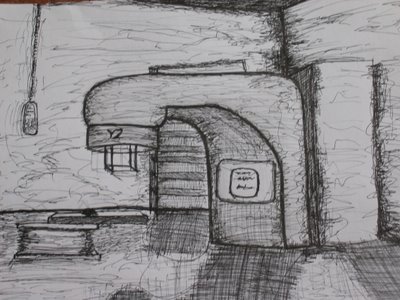
Joel, who has come to at least half the sessions with me, also brought the radiologists a present, a drawing he did over the weekend, from memory, of the second machine, viz:
Robyn and Peter will cook risotto for us tonight. And yesterday, when the temperature soared above 40, Paul's mother came and stood for hours in our sunny living room ironing right down to the bottom of the laundry baskets. At one point, it was so hot she moved the ironing board into the bathroom where it was slightly cooler. And it's not as if Jean doesn't have her own health problems. This was an act of love indeed: if ironing can save me, I'll live to be a hundred.
So I've finished the radiotherapy; Suzanne doesn't want to see me for nine months; and I think I heard Mitchell utter a cautious sentence yesterday with the word 'cure' in it. I'd give anything to wind back the clock again and listen properly. There are five more years of daily Tamoxifen tablets and monthly Triptorelin injections before he's finished with me, but in any case, I knew after my surgery that my prognosis would be good. Everything's gone smoothly; I've been treated beautifully; and my chances — and they are nothing but chances now — are good. The future looks bright.
I feel dreadful.
I'm a mess of sentiment and emotion. Margot came to the door yesterday afternoon and I fell into her arms sobbing. I started to cry all over the mohair rug today, and even more when Joel put his arm around me and laughed with me. I know I am not alone, too. This afternoon as I was joking with Janine and Barbara at my last session, my mother told me there was an old man in the waiting room, looking frail and holding his head in his hand as he cried quietly. And I saw a young woman in her twenties looking grey and drawn with her healthy, anxious partner looking at me in disbelief as I walked out smiling and joking and saying goodbye. (I still don't really look sick.)
The word I use to myself most often these days is 'overwhelmed'. It takes many forms, but today I keep thinking of the wonder of the body and what it can do. I've had a cluster of abnormal cells develop into a tumour that moved beyond the milk duct but no further into the lymph system. This milk duct also fed the child who was born of another extraordinary division of cells, who is now able to draw a picture of the machine that has helped cleanse me of any stray aberrant ones.
I'm pretty sure that if my case had been more serious, I would have been less willing and able to write about it. In almost every sentence I've written, I've been conscious that my case has been relatively mild. But it's been miraculous, all the same.
Perhaps strangest of all, on such a momentous day, after a sleepless night, I've had a good idea about how to structure the chapters in the Garter book. I've been just chipping away at this project over the last week or so for a few hours in the morning, and think I have found a way to establish different writing registers within the book.
Now ... OK, tomorrow ... it's time to turn attention back to the Piers Plowman essay, and to the re-submission of our big ARC grant. This is going to be pretty terrible, as we had polished and tuned every last detail this year, and now we want to make some changes to the scope of the project, which will affect every paragraph, every budget line, every hyphen-break. Oh well. At least I have my health.
Paul set off early on his long-delayed trip to East Timor this morning, and my parents drove up from Grovedale to take me in to the hospital, bringing thoughtfully prepared pies and meals Joel and I can either heat and eat, or freeze for later. Example: a chicken and leek pie in a throw-away tinfoil case (no cooking; no washing up). They also brought me a fabulous present: a soft blue and white mohair throw-rug of dreamy lightness for my afternoon nap. It will be like sleeping in a cloud. OK, better for days when they aren't invoking the 'extreme heat' rule at the Australian Open tennis down the road, but still.
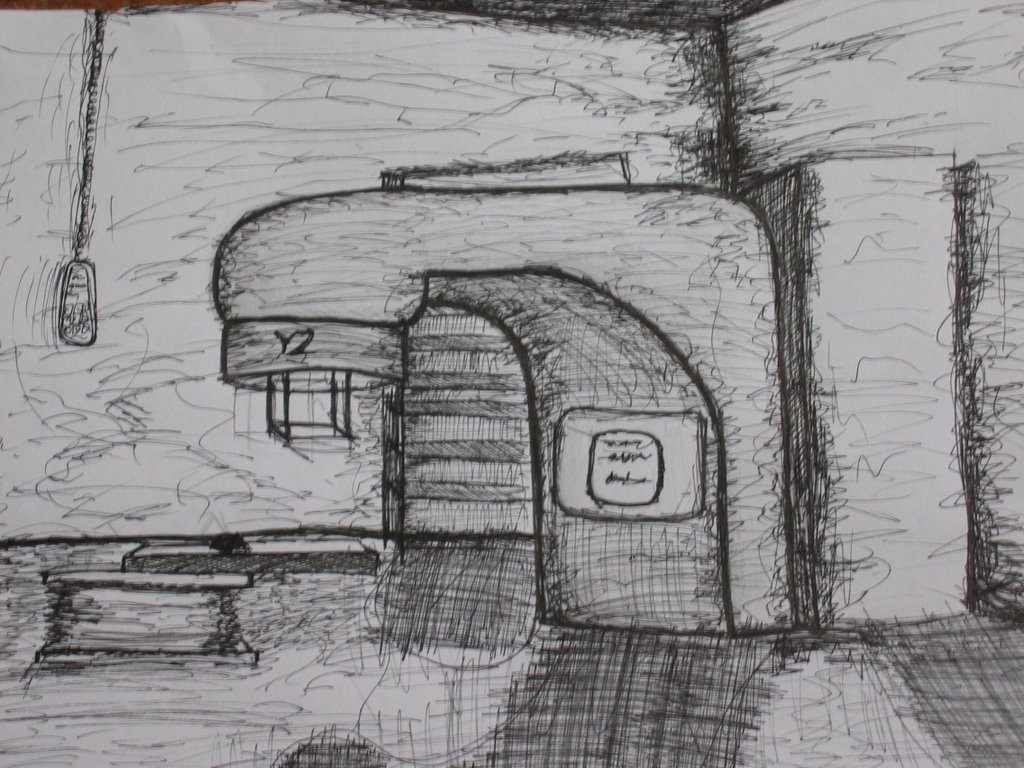
Joel, who has come to at least half the sessions with me, also brought the radiologists a present, a drawing he did over the weekend, from memory, of the second machine, viz:
Robyn and Peter will cook risotto for us tonight. And yesterday, when the temperature soared above 40, Paul's mother came and stood for hours in our sunny living room ironing right down to the bottom of the laundry baskets. At one point, it was so hot she moved the ironing board into the bathroom where it was slightly cooler. And it's not as if Jean doesn't have her own health problems. This was an act of love indeed: if ironing can save me, I'll live to be a hundred.
So I've finished the radiotherapy; Suzanne doesn't want to see me for nine months; and I think I heard Mitchell utter a cautious sentence yesterday with the word 'cure' in it. I'd give anything to wind back the clock again and listen properly. There are five more years of daily Tamoxifen tablets and monthly Triptorelin injections before he's finished with me, but in any case, I knew after my surgery that my prognosis would be good. Everything's gone smoothly; I've been treated beautifully; and my chances — and they are nothing but chances now — are good. The future looks bright.
I feel dreadful.
I'm a mess of sentiment and emotion. Margot came to the door yesterday afternoon and I fell into her arms sobbing. I started to cry all over the mohair rug today, and even more when Joel put his arm around me and laughed with me. I know I am not alone, too. This afternoon as I was joking with Janine and Barbara at my last session, my mother told me there was an old man in the waiting room, looking frail and holding his head in his hand as he cried quietly. And I saw a young woman in her twenties looking grey and drawn with her healthy, anxious partner looking at me in disbelief as I walked out smiling and joking and saying goodbye. (I still don't really look sick.)
The word I use to myself most often these days is 'overwhelmed'. It takes many forms, but today I keep thinking of the wonder of the body and what it can do. I've had a cluster of abnormal cells develop into a tumour that moved beyond the milk duct but no further into the lymph system. This milk duct also fed the child who was born of another extraordinary division of cells, who is now able to draw a picture of the machine that has helped cleanse me of any stray aberrant ones.
I'm pretty sure that if my case had been more serious, I would have been less willing and able to write about it. In almost every sentence I've written, I've been conscious that my case has been relatively mild. But it's been miraculous, all the same.
Perhaps strangest of all, on such a momentous day, after a sleepless night, I've had a good idea about how to structure the chapters in the Garter book. I've been just chipping away at this project over the last week or so for a few hours in the morning, and think I have found a way to establish different writing registers within the book.
Now ... OK, tomorrow ... it's time to turn attention back to the Piers Plowman essay, and to the re-submission of our big ARC grant. This is going to be pretty terrible, as we had polished and tuned every last detail this year, and now we want to make some changes to the scope of the project, which will affect every paragraph, every budget line, every hyphen-break. Oh well. At least I have my health.
Saturday, January 13, 2007
Interview with the goddess
The air around the temple is clear and blue. The sound of birdsong floats in and out of the columns, and the water in the fountains is crystalline. The priestess summons you into the inner chamber, and takes you through the preliminary mysteries. Then suddenly the goddess appears. It is bright-eyed Athena: statuesque, yet kindly. She asks you about your life. What have you learned? How have you put her gifts of wisdom to use? How will you answer?
...
A few days ago, my friend Paula took me to radiotherapy and then for my three-month “review” with Suzanne, my surgeon. I like it when my friends and family come with me for a radiotherapy session and see me being lined up under the different machines. And I was pleased for Paula to see the breast clinic, in line with my perpetual message to my women friends: don't be afraid.... We check in at reception: Helene, as ever, is wearing a very chic suit and pearls, with her blonde hair piled up in a stylish chignon. There are jelly beans in a glass dish, and a bowl of apples further along the dark wood counter. The waiting room is light and airy, and has interior design magazines, Vogue, literary journals and art books to look at. The paintings and sculptures are original and interesting. The herbal teas in the jars look fresh and inviting. At discreet intervals, the soundscape of birdsong echoes through the large room. Middle-class women sit reading, or talking quietly with friends or partners. One is wearing a close-fitting hat, though it’s 38 degrees outside. A man walks in carrying x-rays. Is he a supportive partner? or one of the 1% of breast cancer patients who are male?
I won’t beat around the bush, here. This is an expensive practice in the private system. I’m here because my GP, Barbara, has been practising in Melbourne for many, many years, and is deeply networked into Melbourne’s medical and surgical elite. Mitchell, the oncologist, serves on the Victorian Medical Board with Bernadette, the surgeon who delivered my child (a complicated footling breech), with Barbara’s assistance, nearly twelve years ago. This service doesn’t come cheaply, and I know how fortunate I am to be here under Barbara’s introduction, and with the capacity to pay for apples and birdsong. And Suzanne.
I have written earlier about my admiration for this woman, and for the things I am learning from her, as well as for her care of me. I’ll be the first to admit I am a little besotted with her. It’s partly the bourgeois process of “choosing” a specialist, an architect, a doctor, a hairdresser, or an academic patron who is fabulous, and hoping their fabulousness will reflect well on us. And I have always loved a good medical melodrama where patients and doctors discuss metaphysical and existential questions in moments of quiet reflection. And after all, Suzanne has saved my life.
Today her first question is about how I am coping. She wants to know what I am doing about my work, my writing, my feelings about all the committees I was struggling with last year. She is pleased when I say I am learning to turn around my priorities: to answer emails later in the day and work in the mornings when I am fresher; to anticipate only a gradual return to full strength and public duties over the next year, once this acute phase of treatment is over, and when I am ready to emerge from my hibernation. She asks how Paul and Joel are coping, and is pleased when I say Paul cancelled all his travel for the rest of the year and has spent as much time at home as possible; and when I report that the three of us have spent more time together as a family over the last few months than for a while.
Only then does she examine me, looking mostly at how the wounds are healing, and asking about the residual numbness in my arm and the back of my shoulder. To my great surprise, she examines the healthy breast carefully, but barely touches the wounded one. I ask when I should begin to start examining my own breasts again, since I know the chance of recurrence is higher in the first few years after the initial diagnosis. Not for about a year, she says, since people are just too nervous to do it properly. She and Mitchell will take care of it between them; and in fact she doesn't need to see me again until October, when I will have a mammogram and ultrasound on the same day. Her complete and utter confidence that she does not need to reassure herself, or me, that there is no discernible lump in my breast, confirms my great faith in her. I feel this is going to be a crucial moment to revisit when I am ready to start building my confidence again. I can see that once visited by the disease, it will be hard to set aside the fear of its recurrence.
Suzanne is charismatic for me because of her quiet authority and stillness in her workplace, in a phase in my life where I feel fragmented and divided from my own. It's no wonder I seek to channel a little Athena-like strength through her.
...
A few days ago, my friend Paula took me to radiotherapy and then for my three-month “review” with Suzanne, my surgeon. I like it when my friends and family come with me for a radiotherapy session and see me being lined up under the different machines. And I was pleased for Paula to see the breast clinic, in line with my perpetual message to my women friends: don't be afraid.... We check in at reception: Helene, as ever, is wearing a very chic suit and pearls, with her blonde hair piled up in a stylish chignon. There are jelly beans in a glass dish, and a bowl of apples further along the dark wood counter. The waiting room is light and airy, and has interior design magazines, Vogue, literary journals and art books to look at. The paintings and sculptures are original and interesting. The herbal teas in the jars look fresh and inviting. At discreet intervals, the soundscape of birdsong echoes through the large room. Middle-class women sit reading, or talking quietly with friends or partners. One is wearing a close-fitting hat, though it’s 38 degrees outside. A man walks in carrying x-rays. Is he a supportive partner? or one of the 1% of breast cancer patients who are male?
I won’t beat around the bush, here. This is an expensive practice in the private system. I’m here because my GP, Barbara, has been practising in Melbourne for many, many years, and is deeply networked into Melbourne’s medical and surgical elite. Mitchell, the oncologist, serves on the Victorian Medical Board with Bernadette, the surgeon who delivered my child (a complicated footling breech), with Barbara’s assistance, nearly twelve years ago. This service doesn’t come cheaply, and I know how fortunate I am to be here under Barbara’s introduction, and with the capacity to pay for apples and birdsong. And Suzanne.
I have written earlier about my admiration for this woman, and for the things I am learning from her, as well as for her care of me. I’ll be the first to admit I am a little besotted with her. It’s partly the bourgeois process of “choosing” a specialist, an architect, a doctor, a hairdresser, or an academic patron who is fabulous, and hoping their fabulousness will reflect well on us. And I have always loved a good medical melodrama where patients and doctors discuss metaphysical and existential questions in moments of quiet reflection. And after all, Suzanne has saved my life.
Today her first question is about how I am coping. She wants to know what I am doing about my work, my writing, my feelings about all the committees I was struggling with last year. She is pleased when I say I am learning to turn around my priorities: to answer emails later in the day and work in the mornings when I am fresher; to anticipate only a gradual return to full strength and public duties over the next year, once this acute phase of treatment is over, and when I am ready to emerge from my hibernation. She asks how Paul and Joel are coping, and is pleased when I say Paul cancelled all his travel for the rest of the year and has spent as much time at home as possible; and when I report that the three of us have spent more time together as a family over the last few months than for a while.
Only then does she examine me, looking mostly at how the wounds are healing, and asking about the residual numbness in my arm and the back of my shoulder. To my great surprise, she examines the healthy breast carefully, but barely touches the wounded one. I ask when I should begin to start examining my own breasts again, since I know the chance of recurrence is higher in the first few years after the initial diagnosis. Not for about a year, she says, since people are just too nervous to do it properly. She and Mitchell will take care of it between them; and in fact she doesn't need to see me again until October, when I will have a mammogram and ultrasound on the same day. Her complete and utter confidence that she does not need to reassure herself, or me, that there is no discernible lump in my breast, confirms my great faith in her. I feel this is going to be a crucial moment to revisit when I am ready to start building my confidence again. I can see that once visited by the disease, it will be hard to set aside the fear of its recurrence.
Suzanne is charismatic for me because of her quiet authority and stillness in her workplace, in a phase in my life where I feel fragmented and divided from my own. It's no wonder I seek to channel a little Athena-like strength through her.
Wednesday, January 10, 2007
Other stories, other lives
When I first received my cancer diagnosis, I began to think about other women I knew who had breast cancer. Two women I knew of in my faculty; a historian in another state I admire hugely; Kylie Minogue; and then Belinda Emmett, a starlet who died in a Sydney hospital the night Kylie made her first triumphant return, around the time I was having my surgery. And pretty chilling that was for me, too. Sheryl Crow. Linda McCartney. Anastasia. Susan Sontag. Jane McGrath. A second cousin, much younger than I, who's had a complete mastectomy. Fanny Burney, who famously described her mastectomy in 1811, without anaesthesia, feeling the knife scrape down to the bone, but going on to live another seventeen years.
Once I started reading around, I read dozens of other women's stories, in the support literature, and online. And since writing the blog, I've learned of many more: Meredith at Marrickvillia for example, whom I knew years ago at Melbourne. She doesn't write much about her experience with breast cancer last year, but has recently posted a retrospective as she heads off on holiday. Many friends have emailed to tell me their own stories, or those of friends and relations. I'm glad to be part of this company, though I haven't yet considered joining any kind of support group.
What is it possible to learn from these others, and these stories? That sometimes women die of breast cancer if it spreads to other parts of the body and can't be controlled; but sometimes they die much later, quietly in their beds like other people, or in war, or of other diseases, or of stupid traffic accidents. That some women are terrified and shocked when they first hear the news; that many have a much harder time of it than I have had, especially those who undergo chemotherapy and endure complications from side-effects and fertility issues; and that for most it produces some change in the way they live, or in who they are.
Amongst the medievalists, my friends have reminded me of Kellie Robertson, at Pittsburgh, who was diagnosed and treated about seven years ago. I've not exchanged more than a word or two, if that, with Kellie, but I've seen her presenting at conferences, and she is something else. She gives a great talk, and I find her energy and engagement inspiring. I also have her book, The Laborer's Two Bodies, on my desk, as I slowly think about the nature of the acts of writing, as work, and as pleasure, in Piers Plowman.
On the web, I came across Kellie's account of her year with breast cancer here. Her diagnosis, type of tumour, and treatment are all different to mine, and as a much younger woman, cancer raised different issues for her, too. But it was great for me to read her account (partly because it's so bracing and compelling; and partly because we inhabit such similar intellectual and collegial spaces) and also to see from my correspondence with her this week that she has become something of an activist. I've put up a link to the Breast Cancer Action site she directed me to, and I was intrigued to follow its critique of the pink consumerism that surrounds breast cancer in October. Just how much of your donation goes to breast cancer research? and of what kind? to support a drug company? or support networks? or just "awareness"? Do the pink ribbon cosmetic or food or water companies you support use chemicals or packaging that might actually be endangering our health and our environment? This is a big theme on this site: I don't know enough to say more about these concerns, but I think they are good questions to ask.
I've now finished the 25 standard radiation treatments, and started the 8 "booster" shots, just along the scar area. It's a different machine, one that comes much closer as I lie on my side. I saw Michael for my weekly check-up on Monday and he said I had tanned up nicely; and it's true. The area under the breast is no longer pink and burned but is a deep dark tan: I could have been in an ad for Reef Oil as a teenager, and gone very, very brown if I had ever had the patience to lie long enough in the sun. The skin along the scar is still tender and feels burned, though, and the skin on the nipple has started to peel. Ouch. And the other breast seems startlingly smooth and white in comparison. But it's not a medical breast, so I can't write about it here. I'm still doing ok. I now know what radiotherapy fatigue is like, though. Not just sleepiness, but also a feeling that my limbs and my eyelids weigh at least twice as much as they did last week. I'm also growing some rather dark shadows under my eyes. Small prices to pay, I say.
Once I started reading around, I read dozens of other women's stories, in the support literature, and online. And since writing the blog, I've learned of many more: Meredith at Marrickvillia for example, whom I knew years ago at Melbourne. She doesn't write much about her experience with breast cancer last year, but has recently posted a retrospective as she heads off on holiday. Many friends have emailed to tell me their own stories, or those of friends and relations. I'm glad to be part of this company, though I haven't yet considered joining any kind of support group.
What is it possible to learn from these others, and these stories? That sometimes women die of breast cancer if it spreads to other parts of the body and can't be controlled; but sometimes they die much later, quietly in their beds like other people, or in war, or of other diseases, or of stupid traffic accidents. That some women are terrified and shocked when they first hear the news; that many have a much harder time of it than I have had, especially those who undergo chemotherapy and endure complications from side-effects and fertility issues; and that for most it produces some change in the way they live, or in who they are.
Amongst the medievalists, my friends have reminded me of Kellie Robertson, at Pittsburgh, who was diagnosed and treated about seven years ago. I've not exchanged more than a word or two, if that, with Kellie, but I've seen her presenting at conferences, and she is something else. She gives a great talk, and I find her energy and engagement inspiring. I also have her book, The Laborer's Two Bodies, on my desk, as I slowly think about the nature of the acts of writing, as work, and as pleasure, in Piers Plowman.
On the web, I came across Kellie's account of her year with breast cancer here. Her diagnosis, type of tumour, and treatment are all different to mine, and as a much younger woman, cancer raised different issues for her, too. But it was great for me to read her account (partly because it's so bracing and compelling; and partly because we inhabit such similar intellectual and collegial spaces) and also to see from my correspondence with her this week that she has become something of an activist. I've put up a link to the Breast Cancer Action site she directed me to, and I was intrigued to follow its critique of the pink consumerism that surrounds breast cancer in October. Just how much of your donation goes to breast cancer research? and of what kind? to support a drug company? or support networks? or just "awareness"? Do the pink ribbon cosmetic or food or water companies you support use chemicals or packaging that might actually be endangering our health and our environment? This is a big theme on this site: I don't know enough to say more about these concerns, but I think they are good questions to ask.
I've now finished the 25 standard radiation treatments, and started the 8 "booster" shots, just along the scar area. It's a different machine, one that comes much closer as I lie on my side. I saw Michael for my weekly check-up on Monday and he said I had tanned up nicely; and it's true. The area under the breast is no longer pink and burned but is a deep dark tan: I could have been in an ad for Reef Oil as a teenager, and gone very, very brown if I had ever had the patience to lie long enough in the sun. The skin along the scar is still tender and feels burned, though, and the skin on the nipple has started to peel. Ouch. And the other breast seems startlingly smooth and white in comparison. But it's not a medical breast, so I can't write about it here. I'm still doing ok. I now know what radiotherapy fatigue is like, though. Not just sleepiness, but also a feeling that my limbs and my eyelids weigh at least twice as much as they did last week. I'm also growing some rather dark shadows under my eyes. Small prices to pay, I say.
Monday, January 01, 2007
Cricket as Metaphor
I’m not sure of the origins of the idea that cricket is a metaphor for life. But for anyone interested, as I am, in the practice of discourse analysis, ideas of nationalism, medievalism, the relation between individuals and institutions, in rituals, cricket, convalescence and the monarchy, the current Ashes tour of Australia provides fascinating and ample fodder. Note to US readers: England is currently on tour in Australia, to play a “best of 5” series, played every 18 months or so in alternate countries. Each game can last up to five days. Australia leads the current series 4-0 (in a game where a draw is not uncommon). The final test starts in Sydney tomorrow.
Here are the parameters of my interest:
• AS an invalid, I’m allowed to watch as much televised cricket as I like this summer.
• CRICKET commentary (on radio and in print) has long been my delight, for its brilliant and/or hyperbolic use of metaphor and meta-narrative. Shane Warne’s announcement of his retirement after the Sydney game brought out this from Peter Roebuck:
"Shane Warne has been the most extraordinary, exotic and entertaining cricketer the game has known. In his hands, a cricket ball could perform previously unconsidered gyrations, spinning at right angles, skidding like a puck upon ice, changing directions after an initial curl or else dropping sharply to leave the batsman groping at thin air.
"He took a bag of tricks onto the field and dipped into it with the cunning of a rat and the theatricality of a tragedian. And now the end is near. Treasure these last few days as the old rascal pitches another jewel of a leg-break or carts another irreverent 40 or plots another clever dismissal or presides over another imposing performance. Treasure them because we will not see his like again."
• I'VE cherished a long-standing interest in tracking metaphors drawn from medieval culture in sporting discourse (this might even become a Research Topic one day). E.g. Greg Baum on the English capitulation in Adelaide: “Like medieval royals with syphilis, they went suddenly mad. England lost its last nine wickets for 60, the same England that made 6-551 declared in the first innings.”
• THE Ashes rivalry is deeply colonialist: the little urn we fight over contains the ashes of the bales burned by some Melbourne women after Australia first defeated the English in 1882, to signify the death of English cricket, as reported by the English media, thus inaugurating a tradition of the English press savaging any unsuccessful national team. How do sporting teams come to represent the national character? Martin Johnson explains:
"What seemed to catch England unawares here, for reasons that will take a bit of explaining, is that Australia's reaction to losing the Ashes [in 2005] was a bit like Scotland Yard's on discovering that the crown jewels had been stolen.
"The Australians have been intense, intimidating, downright nasty at times, but while they are the equivalent of a long-distance truck driver ploughing on beyond the health and safety regulations, England can only go so far before pulling into the service station for a mug of tea and a kip."
• AS an old game, cricket is replete with an elaborate set of rules and rituals. When any umpiring decision is in doubt, the rule book says “the spirit of the game” should be invoked as the deciding principle. (Note to medievalists: cf. Augustine's rule of "caritas" in scriptural exegesis.) This is ritual practice in action, as the game veers between wanting to modernise itself to attract new audiences, and wanting to uphold its own traditions (cricket thus parallels my interest in English ritual practice and the monarchy’s struggle between tradition and modernity: and yes, the Helen Mirren movie The Queen was made in order to prove my current research thesis on the Order of the Garter). Peter Lalor described Adam Gilchrist taking some beer to the ground staff in Perth after the third test as proof that the Australians are “not only better cricketers, they are morally superior too” (tongue-in-cheek, but nevertheless, printed). Jonathan Agnew’s blog on the BBC website, and his mention of the MBEs awarded to the English team in 2005 attracted the following comment: "I agree totally with MZ, the England team should be ashamed of their efforts, no will to fight etc. They should all hand back their stupid honours from last year’s streaky Ashes win. It just shows what an outdated system both cricket and the honours are in England!"
• MY son has started to play cricket so this summer I am attending training sessions and games of the Edinburgh Under 12s, watching these young boys being taught this “spirit”, and the principles and conventions of the game. In the last game before the January recess I watched one frustrated young batsman calling out to his teammate: “Come on, go out!”, as he could see the innings drawing to a close without getting a chance to bat. There has been some stern lecturing from the coach, an extraordinary 18-year-old, on the protocols of cheering and applauding the successes of both teams.
• AS a game, cricket is curiously poised between individual and team performances, so for people like me, who identify strongly with their workplace and who also compete against themselves, it’s a fascinating analogy played out in public. This isn’t an issue just for the juniors. There was an extraordinary interchange this week between the Australian coach John Buchanan and the middle-order English batsman Kevin Pietersen. Buchanan accused Pietersen of not being a team player, to which Pietersen responded:
"I've also been helping Monty Panesar big-time. It's just ridiculous Buchanan has come out with such a bizarre statement. And if I wasn't a team player, I could say, I've played my part — I've scored 420 runs at an average of 60 but what about the others? But you will never hear that from me. Cricket's a team game."
Oh good; I’m glad that’s clear!
THIS last point, apart from the excesses of the Pietersen case, is the one that resonates most strongly for me this week, as I think about the relationship between my work and my life over the last very odd months, and as I contemplate the idea of re-entry once this intense phase of my treatment is over and I can establish some modest work routines. The achievements of sportspeople are very much more public than the work of academic scholars, yet our successes and failures are equally visible and public to those in our small circles. Is academic culture more, or less forgiving than public sporting culture? In an institutional context where we are made to measure ourselves and our colleagues all the time, what's to stop us all becoming as self-promotional as Pietersen?
Here are the parameters of my interest:
• AS an invalid, I’m allowed to watch as much televised cricket as I like this summer.
• CRICKET commentary (on radio and in print) has long been my delight, for its brilliant and/or hyperbolic use of metaphor and meta-narrative. Shane Warne’s announcement of his retirement after the Sydney game brought out this from Peter Roebuck:
"Shane Warne has been the most extraordinary, exotic and entertaining cricketer the game has known. In his hands, a cricket ball could perform previously unconsidered gyrations, spinning at right angles, skidding like a puck upon ice, changing directions after an initial curl or else dropping sharply to leave the batsman groping at thin air.
"He took a bag of tricks onto the field and dipped into it with the cunning of a rat and the theatricality of a tragedian. And now the end is near. Treasure these last few days as the old rascal pitches another jewel of a leg-break or carts another irreverent 40 or plots another clever dismissal or presides over another imposing performance. Treasure them because we will not see his like again."
• I'VE cherished a long-standing interest in tracking metaphors drawn from medieval culture in sporting discourse (this might even become a Research Topic one day). E.g. Greg Baum on the English capitulation in Adelaide: “Like medieval royals with syphilis, they went suddenly mad. England lost its last nine wickets for 60, the same England that made 6-551 declared in the first innings.”
•
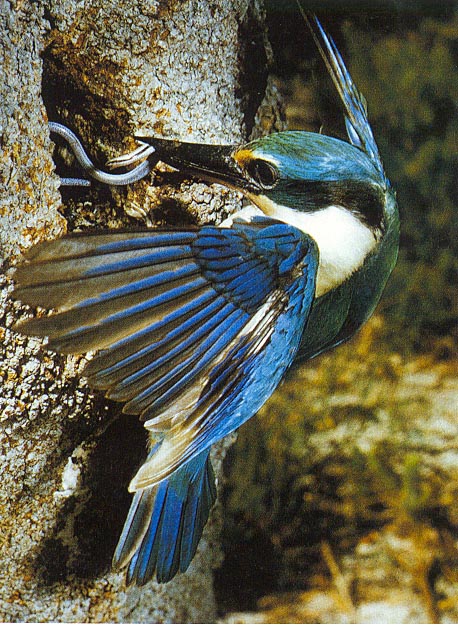 THE Ashes rivalry is deeply colonialist: the little urn we fight over contains the ashes of the bales burned by some Melbourne women after Australia first defeated the English in 1882, to signify the death of English cricket, as reported by the English media, thus inaugurating a tradition of the English press savaging any unsuccessful national team. How do sporting teams come to represent the national character? Martin Johnson explains:
"What seemed to catch England unawares here, for reasons that will take a bit of explaining, is that Australia's reaction to losing the Ashes [in 2005] was a bit like Scotland Yard's on discovering that the crown jewels had been stolen.
"The Australians have been intense, intimidating, downright nasty at times, but while they are the equivalent of a long-distance truck driver ploughing on beyond the health and safety regulations, England can only go so far before pulling into the service station for a mug of tea and a kip."
• AS an old game, cricket is replete with an elaborate set of rules and rituals. When any umpiring decision is in doubt, the rule book says “the spirit of the game” should be invoked as the deciding principle. (Note to medievalists: cf. Augustine's rule of "caritas" in scriptural exegesis.) This is ritual practice in action, as the game veers between wanting to modernise itself to attract new audiences, and wanting to uphold its own traditions (cricket thus parallels my interest in English ritual practice and the monarchy’s struggle between tradition and modernity: and yes, the Helen Mirren movie The Queen was made in order to prove my current research thesis on the Order of the Garter). Peter Lalor described Adam Gilchrist taking some beer to the ground staff in Perth after the third test as proof that the Australians are “not only better cricketers, they are morally superior too” (tongue-in-cheek, but nevertheless, printed). Jonathan Agnew’s blog on the BBC website, and his mention of the MBEs awarded to the English team in 2005 attracted the following comment: "I agree totally with MZ, the England team should be ashamed of their efforts, no will to fight etc. They should all hand back their stupid honours from last year’s streaky Ashes win. It just shows what an outdated system both cricket and the honours are in England!"
• MY son has started to play cricket so this summer I am attending training sessions and games of the Edinburgh Under 12s, watching these young boys being taught this “spirit”, and the principles and conventions of the game. In the last game before the January recess I watched one frustrated young batsman calling out to his teammate: “Come on, go out!”, as he could see the innings drawing to a close without getting a chance to bat. There has been some stern lecturing from the coach, an extraordinary 18-year-old, on the protocols of cheering and applauding the successes of both teams.
• AS a game, cricket is curiously poised between individual and team performances, so for people like me, who identify strongly with their workplace and who also compete against themselves, it’s a fascinating analogy played out in public. This isn’t an issue just for the juniors. There was an extraordinary interchange this week between the Australian coach John Buchanan and the middle-order English batsman Kevin Pietersen. Buchanan accused Pietersen of not being a team player, to which Pietersen responded:
"I've also been helping Monty Panesar big-time. It's just ridiculous Buchanan has come out with such a bizarre statement. And if I wasn't a team player, I could say, I've played my part — I've scored 420 runs at an average of 60 but what about the others? But you will never hear that from me. Cricket's a team game."
Oh good; I’m glad that’s clear!
THIS last point, apart from the excesses of the Pietersen case, is the one that resonates most strongly for me this week, as I think about the relationship between my work and my life over the last very odd months, and as I contemplate the idea of re-entry once this intense phase of my treatment is over and I can establish some modest work routines. The achievements of sportspeople are very much more public than the work of academic scholars, yet our successes and failures are equally visible and public to those in our small circles. Is academic culture more, or less forgiving than public sporting culture? In an institutional context where we are made to measure ourselves and our colleagues all the time, what's to stop us all becoming as self-promotional as Pietersen?
Subscribe to:
Posts (Atom)

 Posts
Posts


