2016

I've kept this blog, on and off, since 2006. In 2015 I used it to chart daily encounters, images, thoughts and feelings about volcanic basalt/bluestone in Melbourne and Victoria, especially in the first part of the year. I plan to write a book provisionally titled Bluestone: An Emotional History, about human uses of and feelings for bluestone. But I am also working on quite a few other projects and a big grant application, especially now I am on research leave. I'm working mostly from home, then, for six months, and will need online sociability for company!


Friday, March 13, 2015

My Year with Bluestone: Friday House Day (7) Into the Earth we go...

When we demolished the back half of our house in 1999, Paul thought it would be a good idea to dig a wine cellar to go underneath the new extension. He started by pulling up the floor of the only ever half built bathroom. Weirdly, this bathroom stood as a self-contained square in the middle of the old extension: you could actually walk all the way around it.


He started digging a few months before the builders came to pull down the back of the house. We had no spare money so stayed in the house. Our builders moved our sink and stove into the loungeroom so we could cook. We had a hose to come through the window, and emptied the sink into a bucket. We had a portable shower and toilet in the back garden for months, and I used to bathe Joel in a big plastic toybox. Fun times!

But before all that, Paul started digging in the bathroom. At first it was just a small hole you could cover up at night; then eventually the bath had to come out. Digging down beneath layers of bricks he first came to layers of sticky black clay. It seemed unaccountably wet, too, till he realised there was a leak from one of the water pipes...And we sent small children down to do the work.


Then he hit the layer of huge bluestone boulders, jammed in together and stuck to each other with clay. They were too big to lift out, despite enormous crowbars, levers, and concrete breakers. So he hired a series of larger and larger jackhammers to break them up. At one point I looked down and saw him covered in black dust, holding up an enormous jackhammer, powered by a small generator/compressor, as it dug into a rock in front of his waist. Not your best OHS practice. And the house was soon full of black dust and sticky mud. It became a race to get it dug before the builders arrived. Soon they arrived to pull down the back of the house. They would work during the day; Paul would start in the afternoon, digging and digging, enlisting various friends to come and help.


I notice in this photograph below I am wearing a white linen frock; didn't seem to be getting down and dirty at all, myself.


Around the northern suburbs, lots of houses have small cellars for wine, cunningly concealed under floorboards, where you might keep a few boxes in the lovely coolth. But because this was being dug under a new construction, it was subject to all kinds of regulations about reinforcement. We originally had plans for something grandiose like two rooms you could stand up in.... But that was without accounting for the bluestone, that was so hard to dig out. It was physically exhausting, and dispiriting and very very slow, so it became smaller and smaller.


The piles of bluestone by the side of the house stayed there for several years...

And then the night before they were going to put in the scaffolding, Paul realised the layers of concrete and reinforcing were going to be so thick they would mean it would hardly be deep enough to stand up in, so in a super human effort he managed to clear another six inches of depth. It was almost heartbreaking to see how much of his labour went to make room for the frame and the two layers of steel mesh.


Anyway it is now a beautiful and secret place under the house. You can stand up in it, and we have transformed lots of rather ordinary wine into much better wines. And the good wines have become great. So, not a romantic bluestone-lined cellar to look at; but a place forever associated with the blood, sweat and tears of my cellar-loving, bluestone-breaking man.




Thursday, March 12, 2015

My Year with Bluestone: Regency Melbourne plus brilliant idea.

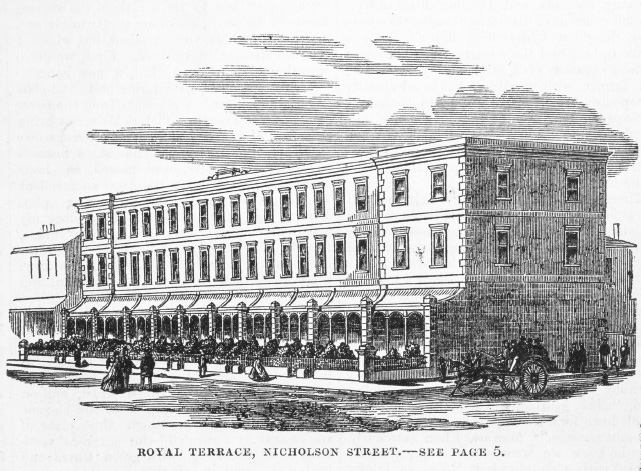
One of the most striking pieces of domestic bluestone architecture is this long terrace of ten three-storey bluestone terraces in Nicholson St, opposite the Carlton Gardens and the Exhibition Building.


The building was commissioned by timber merchant and builder John Bryant in 1853, two years after the discovery of gold in Victoria. He lived here, and rented others of the houses to wealthy gold-rich tenants.

Here is an engraving by the architect John Gill (who also designed the Goldsborough building), published in the Illustrated Melbourne Post in 1862.

http://www3.slv.vic.gov.au/latrobejournal/issue/latrobe-88/fig-latrobe-88-055a.html


And a paragraph from the "on my doorstep" web page: 
Royal Terrace is of architectural significance as the largest early terrace building surviving in Melbourne, and is unrivalled amongst the early terraces for its elegance. The simple composition and austere decoration makes it a notable example, albeit a sober one, of the comparatively rare Regency style in Victoria. It has no comparison in terms of scale or quality of stonework to any other extant, early terrace building in the other major urban areas of Australia. It is remarkably intact, most notably the unified facade. The combination of stone and stucco is also particularly unusual. 
It's true that "Victorian" would be the dominant early style in Melbourne, because that's when the city was so prosperous in the 1880s and 1890s. I note the words "sober" and "austere" here, which are part of the regular pattern of bluestone descriptors. 


Brilliant note to self: build a wordcloud of adjectives used to describe bluestone buildings... Must investigate how best to do this.
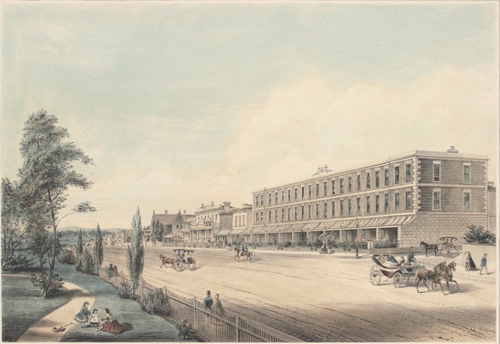
 Walking or cycling or driving past, I've often felt the striped verandah was an unfortunate colour choice, but look at this picture from the late 1850s, from yet another useful blog: Radical Terrace. The stripey verandah was original: but look how wide Nicholson St appears here...


The Radical Terrace site also lists successive prices these houses have sold for, and shows interiors of one that's for sale. They look so similar from the outside, as if frozen in time. Maybe they're wildly inventively decorative inside: maybe they're incredibly run down. They always seem to me rather inscrutable.

 I'll add the remainder of my photos (from last week, on the way to my tax agent in Gertrude St).


Editorial note: I must admit I'm starting to find Blogger's textual interface rather unfriendly: spending too long faffing about trying to smooth font styles and sizes. I do try and make it easy to read but I also find this software rather resistant to editorial control. My apologies. Suppose it's too late to change...

Wednesday, March 11, 2015

My Year with Bluestone: Do you have a research talisman?

I'm returning, today, to a short post I wrote late last year about this little piece of rock I picked up from the Merri Creek:

http://stephanietrigg.blogspot.com.au/2014/12/talismanic-rock-next-years-writing.html

I was thinking about this rock this afternoon when I gave a talk in my department that was a mash-up of two recent papers I've written on Samuel Pepys and the great fire of London, comparing some modern responses to Pepys's journal as a document in the history of emotions; and some texts and objects associated with the Black Saturday bushfires in Victoria in February, 2009.

Here Pepys is writing on the fourth day of the fire:
up to the top of Barkeing steeple, and there saw the saddest sight of desolation that I ever saw. Everywhere great fires. Oyle-cellars and brimstone and other things burning. I became afeared to stay there long; and therefore down again as fast as I could, the fire being spread as far as I could see it (VII, 276)
 But later that day, he went out walking again in Cheapside:
And took up (which I keep by me) a piece of glass of Mercers' chapel in the street, where much more was, so melted and buckled with the heat of the fire, like parchment (VII, 277). 
So too I picked up a piece of basalt from the creekpath by my house, as a talisman of my project. Not quite the same as Pepys' glass, as my stone "speaks" to the present and the future of the writing of my book, not the past as a remembered traumatic event. It's not a nostalgic souvenir, nor a relic. But as my colleague Peter pointed out in question time, Pepys' glass and other objects retrieved from fire function as markers of control. Several of the objects I talked about were forged and/or fused by fire, collected and held for a while by home owners, then eventually given to the Museum. These objects are like Freud's child's cotton reel in the fort-da game: the child learns to compensate for/control the absence of the mother with control over the disappearance and reappearance of the object.

Talisman seems the right word here. But what is a talisman? According to the OED, the word is of Arabic origins, and means something like an amulet, a magic, occult or powerful object, perhaps a ring inscribed with occult signs of astrological or planetary configurations. (There's nothing etymologically "manlike" about the suffix.) I don't think I really knew what this word meant, and was embracing the idea of something secular, but looks as if the word means a good luck charm. I suppose, in the end, that's what it's for.

And after giving my paper today (even to gorgeous local colleagues) I realised again, how much we subject ourselves to scrutiny and judgement in our work. I am happy with my two papers, but was very nervous about submitting myself to my colleagues' judgements. I currently have some work on other projects being read by referees, too, as academics usually do. So it's not surprising if I should seek a way to control such anxiety with my little rock that I can grasp in my hand, and measure its physical limits as the project grows and grows.

So here's my question for researchers. Do you have a talisman?

Tuesday, March 10, 2015

My Year with Bluestone: Au Natural

Today we move away from the examples of built and re-built bluestone to focus back on the arrival of bluestone in Melbourne, along volcanic basalt flows, past my house, along the Merri Creek, down towards the junction with the Yarra river.

This is the more geological aspect of my project where I am most outside my comfort zone, and where it is convenient to remind myself that this blog is a place-holder for some more sustained research in second semester.

Some of the geological sites and books I have started to look at were very difficult to understand, so I am delighted to discover the website of the Merri Creek Management Committee, a body formed in 1989 to protect and manage this vulnerable waterway (lined with industrial sites and subject to heavy erosion by the planting of European trees: truly, I wept when the willow trees were removed, but I'm over that now and glad to see more and more birdlife coming back to the creek).

I was going to post just my two pictures of basalt piles along the Creek in Clifton Hill,


but then found this site with its own pictures and analysis of what we are seeing here, though I confess I can't quite match up my images with theirs of Sites No. 3 and No. 6 (there are at least 45 listed on their website). Here's a paragraph of geological description: I need to find out more about "vescicles" and also need to go back and find ... the Cave!!

The principal feature is a very clear exposure of at least two lava flows or flow units that form a vertical cliff face adjacent to the low level crossing of the Merri Creek by the Merri Path at the west of Creek Parade, The lowermost sections of the flows exposed are at creek level 30 metres east of the low bridge on the Merri Path. This flow is ropy with many large aligned vesicles and probably represents a thin cooling flow unit (or several units) with rapid gas escape forming aligned and elongated gas bubble holes. The flow is well exposed as it is frequently washed clean of weathered debris by floods in the Merri Creek. Overlying this and well exposed adjacent to the bridge is a massive non-ropy lava flow with complex jointing and weathering features. The lower 3 metres of the flow has persistent vertical joints with a spacing of 40 cm to 50 cm giving a distinct columnar form. Closely spaced but irregular horizontal joints divide the columns into angular sub-blocks. Overlying the columnar section with a disjunct boundary, the upper part of the flow has disorganised jointing giving an irregular fractured surface

The websites also register concern about graffiti and souveniring from the sites: people do seem to want their own little bit of bluestone, even if it means putting the natural site at risk.


Monday, March 09, 2015

My Year with Bluestone: Little House for a Big Day

It's been a huge day today: scrambling to rewrite a perfectly good lecture from last year on the Nun's Priest's Tale to discuss the Wife of Bath, instead, for a colleague's subject on Adaptation. Great fun, but took ages messing about with video clips and pictures. Stayed up too late last night to finish it; got home at seven to eat (luckily Joel had made a vegetable curry over the weekend) and then fall asleep, waking up to watch the all-female panel on QandA. Really not too bad at all.  And now, at 11, two reasonably urgent issues that must be attended to on email.

So here's just a dear little bluestone house I pass on my way to work, up in Drummond St. Note the neatness of its bluestone patterns, its lichen-encrusted slate roof, and the stained glass in its window. I'm not sure, but it looks from the room above at the back, and the way it matches the house on the left, as if the cottage is now part of a much larger street frontage.

Something charming about the size of this cottage, right up on the pavement: but no garden, no verandah, and facing the afternoon sun? Not designed for Australia!!

Friday, March 06, 2015

My Year with Bluestone: Friday House Day (6): Under House to Under Water

Today the Friday House blogging moves inside, and under water. Fifteen years ago we did a major renovation on the old house. We pulled off all the wooden additions to the original brick building (the kitchen with its raw cement floor and gaps between floor and walls, the half-built bathroom, funny little spare bedroom, laundry, outside toilet and utterly shabby but delightful-in-winter sunny passageway. And Paul dug a cellar into the bluestone.

More on the cellar next week but today we feature some of the bluestone rocks Paul pulled out of the ground under what is now the pantry, and stored around the garden for five years till we got this big fish tank. Just as he used them to landscape the garden, he used them here to "riverscape" the tank. These are mostly South American freshwater river fish: catfish, discus fish, clown loaches and a very shy but enormous sailfin gibbiceps who could not be tempted out to appear in the home movie. (The cats, by contrast, made sure they prefaced the movie with typical behaviour: Orlando finding a good spot; then Wulf muscling in and chasing her off.)


The driftwood came from various expeditions: most recently to the Grampians last summer. If you look at the big lump of volcanic stone on the far right, you can see the plane where Paul would have split it with one of the successively larger jackhammers he had to use. Tune in next week to see how he did it, with the help of two small children.

Thursday, March 05, 2015

My Year with Bluestone: Have I found the book's cover?

My friend Kristin is a painter. She lives in a house in Brunswick. The previous owner had built a kind of arty shed in the back garden, using the bluestone pitchers that had previously been the floor of a small dairy on the site.


Kristin's architect built a gorgeous new studio for her and the bluestones became the basis for the garden (she and Chris laid them themselves). Here she is in the doorway:


And here are the stones laid down under the walnut tree, along with Basil's tail:


and a low wall that the brother of her first lodger built.


A few years ago she painted a series of paintings of this bluestone ledge across the seasons. We couldn't afford to buy this painting, but we both love it, and I now think it would be a wonderful cover image for my bluestone book. 

Not only is it a gorgeous and luminous image, and a lovely contrast to the monumental building style that we mostly associate with bluestone, but it's fitting as a cover, too, because bluestone is so often affectionately recycled in this way, and built unevenly. Kristin loves the way it kind of tapers off at the edge. She has been very happy in this house of her own, and while we tend to meet for walks in a park, rather than home visits, I've spent some happy hours in her studio when she's been painting my portrait (this will be the fourth time, I think). Of course book designers will have their own ideas, and of course, of course, I have to write the book and secure a publisher, but it's a bit like writing the contents page: thinking about the cover helps me think about the book.

The first time Kristin painted my portrait was when I first got to know her, over twenty years ago, when she and her then husband, who were living around the corner from me in Princes Hill, bought an old shed in the laneway behind our house to develop as a double studio/darkroom for the painter and photographer. Of course that laneway was a bluestone one!

Wednesday, March 04, 2015

My Year with Bluestone: bluestone and wool

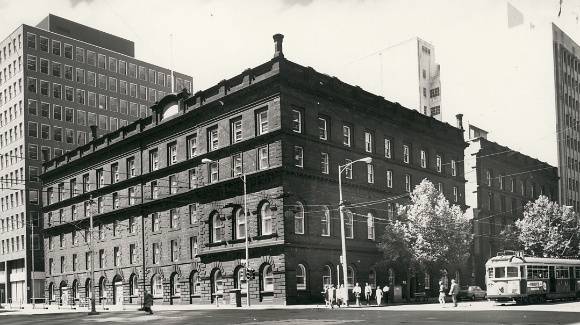
Last week I went into the city to do the kind of work you sometimes do with lawyers, just putting things in place for the future. My sister reminded me to look out for this big bluestone building in William St. It's the Goldsborough Mort building, built in 1862 as a wool warehouse, and later converted into offices. http://vhd.heritage.vic.gov.au/search/nattrust_result_detail/64372
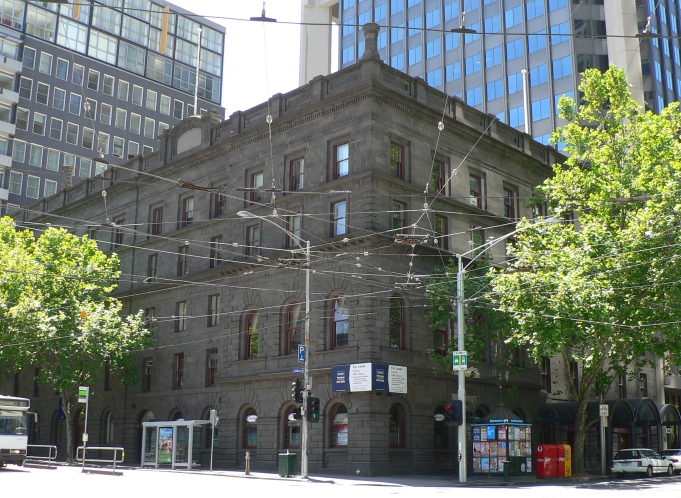
It's an extremely imposing building. I didn't take a photo as I was with my parents and know from experience how hard is to get a big building into a picture close up. And frankly I was preoccupied with my family. And, I thought, I can always go back. But now the significance of the meeting and the moment of registering this building in my mind are knitted very closely together.

I had not anticipated how My Year with Bluestone might become linked in my mind with other milestones. All this is a bit too personal for details here though, so let's focus on the building. I quite like this photo of the corner (from Wikimedia), with the astonishing chimney and the network of tram cables.


But then I thought: what does this building remind me of? And lo and behold: the Medici palace in Florence. Different colour stone, but similar square shape, height, layers of arches, textures of stone. And of course, the Medici were wool merchants, too. Wonder if architect John Gill had this in mind?


Tuesday, March 03, 2015

My Year with Bluestone: How New Yorkers can help with this research project

As further proof that Melbourne is a bluestone city, and one that takes its coffee very seriously, witness the Bluestone Lane coffee group, now in several locations in Manhattan. I had heard of this cafe before, but Anne directed me to this article in the Melbourne Age about what is apparently a distinctive style of cafe now found in New York, and also London, apparently, where Melbourne-trained baristas are making a name for themselves. And now I recall that David Wallace directed me to an Australian-run cafe booth in Tavistock Square, and Alfred Hieatt took me to an Australian cafe (sourdough bread, poached eggs and avocado are distinguishing features of this cuisine) in Victoria Park in Mile End. (Something for Chaucerians to look forward to in 2016.)

I searched the cafe's website and couldn't find very much reference to bluestone, except in the name.

So that's my challenge to anyone living in or passing through NYC: head along to this cafe, try the coffee and see if you can find any pictures of a bluestone laneway!  Ordering a flat white would be the best way to ingratiate yourself with the barista in such a place. And you can practise your accent with this little video:


Monday, March 02, 2015

My Year With Bluestone: Guest Post, in which Grace finds bluestone everywhere

My colleague Grace Moore discovers the wonders of bluestone...


The Ground Beneath My Feet

In my memory, there’s not a lot of bluestone by the beach.  I may be wrong, of course.  I now know that other beaches in the Melbourne area boast plenty of it—Stephanie has blogged about Williamstown in a previous post [Ed. here and here], while the walls that run between Brighton and Beaumaris contain bluestone that may once have rested on top of Ned Kelly and his gang of outlaws.  Probably, I should go back to ‘my’ beach to check, but I’m not quite ready to do that.

Until a few months ago, I’m not sure that I’d ever really given much thought to bluestone, but infectious collegial enthusiasm can change these things very swiftly.  While my younger self wouldn’t have described it in this way, I’ve probably always had an affective relationship with stone.  My father was a keen amateur geologist and my happiest memories of him involve sitting by the hearth, while he proudly displayed and described a variety of rocks that he’d dug up here, there and everywhere. 

There was a piece of volcanic rock, which may have come from Pompeii, although I may also, through the distance of time, be romanticizing its origins.  I remember being intrigued by the little grey piece, with its small bubbles and extraordinary texture.  As a child, I was fascinated by the idea that it had one been molten lava, spewed out of the ground.   As a teenager I was rather less respectful, surreptitiously borrowing it from time to time to smooth my feet.  It’s probably my closest childhood connection to bluestone, and decades later I can feel the memory of its contours on my fingertips as I think back to how it felt.    There was probably more than one piece of basalt in the collection, but it’s on the other side of the world and there is no way for me to check—a single specimen made it to the Antipodes with me, and that’s a flint axe, which sits in my office and occasionally serves as a prop in class. 

In my twenties, I lived for a couple of years in the beautiful volcanic landscape of the Palouse (http://idahoptv.org/outdoors/shows/palouseparadise/geology.cfm  ) not too far away from Mount St Helens in neighbouring Washington State and with a basalt rock formation which I imagine is similar to that which underlies Melbourne.  Beyond the occasional anecdote from residents who’d lived in the region during the major eruption of 1980, I still didn’t think that much about what lay beneath the ground.   The soil was rich and if I’d dug down, I’m likely to have found rock similar to that which I would discover in my back yard today, were I to dig deeply.

Having grown up on the coast, I disliked being landlocked in Idaho and was thrilled to move to Melbourne where, although I never took to the long commute, I loved living by the beach.  For nearly a decade my enormous American dog and I pounded along the sand between Carrum and Seaford twice a day, usually racking up several miles.  If there was bluestone around us, I was never conscious of it, and the outer suburbs tend not to contain the cobbled stone laneways that were built close to Melbourne during the nineteenth century.  Then, just over a year ago, I moved much closer to the city, leaving behind both my beloved beach and Seaford’s glorious wetlands.  Having been spoiled by the great open space by the bay, we struggled a little with the park-based dog culture in the inner north--appreciating it, but still yearning for the sense of intrepid expedition which had been such a feature of our twice-daily jaunts.

At around the time Stephanie began her ‘Year of Bluestone’ blogging, a series of curious bluestone coincidences began to emerge in my own work, and I also discovered the Moonee Ponds Trail.  I’m primarily a Victorian scholar who works with ecocriticism, so it’s unusual for my research to intersect with Stephanie’s, but suddenly there was bluestone everywhere.  As I wrote up a piece on Ned Kelly and fire in the sweltering heat of early January, I was amazed by the number of fleeting references, both in contemporary accounts and modern histories of the outlaw and his gang.  For instance, in 1871, sixteen-year-old Kelly—serving time in the hulks for horse theft—was part of a gang of convicts who built the bluestone sea wall by the beach at Williamstown.  His family home at Beveridge (built by his father when Ned was four) included a bluestone chimney which one recent report describes as having ‘dominated the house’.  I could keep going, but you get the idea.


While I was reading about bluestone, I was also encountering it more and more in my daily life.  In West Brunswick, where I now live, that’s not a particularly remarkable observation.   Bluestone is very much a local material.  One of the first industries in the East of the suburb was the quarrying of bluestone, although by the early 1850s there was little left in the ground, so great was the demand.  Yet bluestone is everywhere and I walk on it every single day.  It forms the gutters and roundabouts, the rickety cobbled side streets are fashioned from it, and one local park even boasts a bluestone barbecue.  These days it comes from quarries far beyond the city limits, perhaps brought in as a tribute to Brunswick’s less metropolitan past.
   

It’s the Moonee Ponds Trail, though, which has consolidated by new-found enthusiasm for the stone, partly because it offers a space for the serious dog-walker and partly because it is trying so hard to bring the country to the city.  The pathway runs alongside what locals call a creek, but what I think of as a canal, and it extends from the northern suburbs to Docklands.  Stretches of it are relentlessly concrete, while other parts (including my own entry point) are quite beautiful, reflecting concerted efforts at (re)vegetation, through the planting of grasses and native trees.  At times, the expanse of cement is almost blinding, yet every so often small patches of bluestone offer relief from the brutalism.

To date, I have no idea whether the bluestone is embedded in the canal walls for structural reasons or aesthetic ones.  My suspicion is that it’s probably a combination of those two things.  In West Brunswick, for instance, the perimeter to the canal is framed by a delicate but sturdy edging strip of the stone, reflecting great care and attention to detail.  Further down the track, though, things look rather more industrial.  While the huge side walls lend themselves to graffiti, for the most part urban artists leave the bluestone alone.  Possibly, this is through respect, although it probably also makes a much rougher canvas than the smooth expanse of concrete that seems to go on for miles.


Noticing bluestone is about learning to appreciate it, and also to love it.  My son, who is eight, and who often accompanies me on dog walks—whizzing along on his scooter—now has an expert eye and will often stop to show me a new piece, or to ask if what he has found is the right stuff.  We peer into people’s gardens, stop outside civic buildings, and occasionally pin down startled neighbours to ask them about their stone.  As I try to intellectualize this process, it seems to offer a thread back to my childhood, whereby I talk to my little boy about rocks, just as my father did to me.  But it’s more than that.  Jeffrey Jerome Cohen writes at the beginning of Prismatic Ecology that ‘an ecosystem is an oikosystem, a dwelling system’ and that’s what bluestone and the long, dog-friendly pathway are offering to me.  An often un-lovely area, where nature and artifice come into direct confrontation, this path is bridging my move from the country to the city and helping me find a new space to love.   Dwelling isn’t always about the four walls of the immediate home—sometimes it’s about the ground beneath our feet and the emotions that environment can foster.